Disclosure: this post contains affiliate links. If you buy through them, we may earn a commission at no extra cost to you.
A power grid emergency is declared when a grid operator can no longer count on having enough electricity to meet demand with a safe margin left over. It usually comes in stages, from a request to conserve power up to orders for rotating outages. If you know what each alert means, you get a head start of minutes to hours to charge up, store water and protect your food before the lights go out.
Quick pick: be ready before the alert turns into an outage
Use: 1-Week Food Supply Ammo Can
14,860 calories in one grab-and-go can, shelf life up to 25 years when stored properly.
Check today’s price
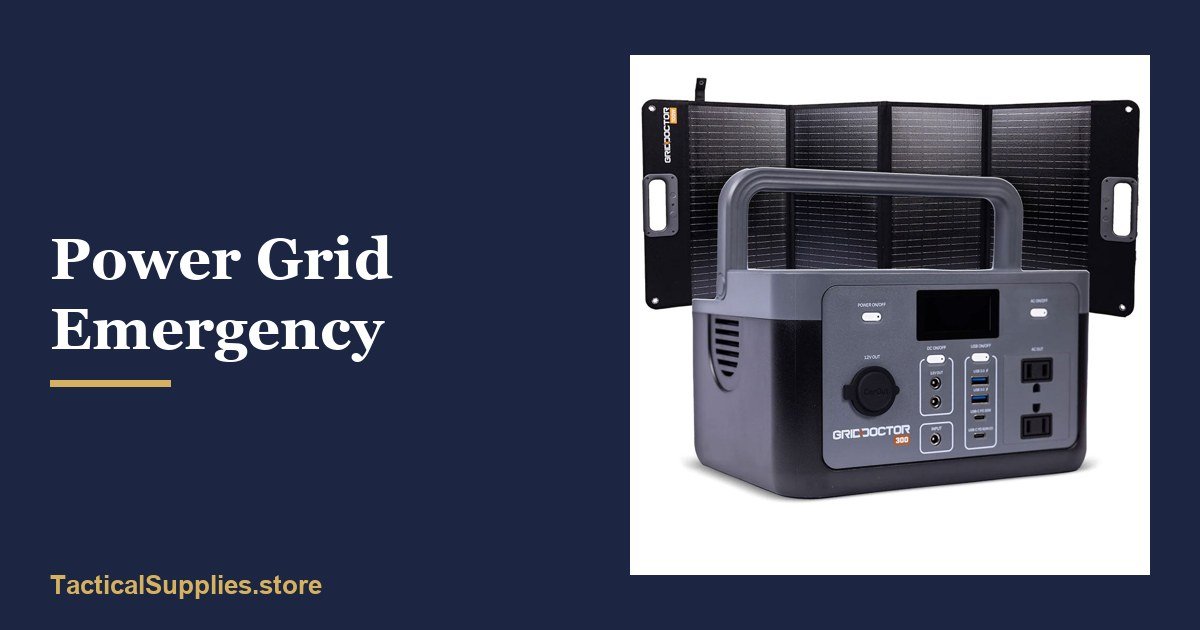
Use: Grid Doctor 300 Solar Generator
Keeps phones, lights, radios and CPAP machines running, with a 100W solar panel included.
Check today’s price
This guide translates grid operator language into plain English, shows what to do at each alert level, and explains why more families (and the military) are planning for grid trouble right now.
What a power grid emergency actually means
Electricity has to be produced the instant it is used. Grid operators, such as ERCOT in Texas or the California Independent System Operator, keep extra generating capacity in reserve in case a power plant trips offline. When those reserves run thin because of extreme heat, extreme cold, plant failures or fuel problems, the operator declares an emergency and starts working down a checklist.
Across North America, those steps follow a standard set by the North American Electric Reliability Corporation (NERC), called Energy Emergency Alerts, or EEAs. Your local operator may use slightly different names, but the order is the same.
The power grid emergency alert levels, in plain English
Before the emergency: conservation appeal
The operator expects tight supply and asks the public to cut back. ERCOT’s guidance is to limit electricity use “to only that consumption which is absolutely necessary,” such as switching off unneeded lights, appliances and electronics. What to do: charge every phone, power bank and battery, run the dishwasher and laundry early, and pre-cool or pre-heat your home.
EEA 1: all available generation in use
Every available power plant is running and the operator is concerned about keeping required reserves. What to do: fill water containers and check your flashlights and battery-backup carbon monoxide detectors.
EEA 2: load management in effect
The operator calls on customers who are paid to reduce use, such as large industrial sites, and uses other emergency tools to hold the grid steady. What to do: assume an outage is likely. Set up your main room, plan meals that don’t need the fridge, and confirm your plan for any medical device.
EEA 3: firm load shed imminent or in progress
This is the point where utilities are ordered to cut power to customers. ERCOT describes these rotating outages as primarily affecting residential neighborhoods and small businesses, typically for 10 to 45 minutes before rotating to a different neighborhood. What to do: unplug sensitive electronics, keep the fridge and freezer closed, and switch to battery lights.
When a power grid emergency becomes a long outage
Most alerts end without anyone losing power. But a big enough shortage can outrun the rotation plan. In February 2021, extreme cold took so much Texas generation offline that many homes stayed dark for days instead of minutes. In August 2020, a West-wide heat wave forced California’s grid operator to order rotating outages, and the state’s final report pointed to extreme weather, resource planning gaps and market practices.
The U.S. Energy Information Administration reports that the average customer had 11 hours of power interruptions in 2024, and customers in South Carolina averaged nearly 53 hours. For the full breakdown of causes, read our guide to power grid failure.
Why the Pentagon is planning for grid trouble
On September 30, the Pentagon announced FORTRESS America, an initiative to make major U.S. military bases able to run on their own power. According to Pentagon documents reviewed by Fox News, major bases in the continental U.S. are being asked to plan to sustain essential operations for at least 90 days independently. The Pentagon has not released the memo publicly, and Snopes rates the reporting “mostly true.” You don’t need 90 days of supplies, but it is a clear sign that serious planners treat the grid as something that can fail. Our FORTRESS America explainer covers what the plan really says.
Your power grid emergency kit: 5 essentials
1. Light and phone power
Ready.gov recommends flashlights for every household member and a backup power source such as a power bank. To keep a router, phones, lights and a CPAP machine going through a long night, the Grid Doctor 300 Solar Generator offers a 320Wh LiFePO4 battery, 300W pure sine wave output and a 100W solar panel. Be honest about its limits: it is not designed for full-size refrigerators, microwaves or space heaters.
2. Food that doesn’t need a fridge
Ready.gov says a refrigerator keeps food cold for about four hours and a full freezer for about 48 hours if the doors stay shut. Past that, you need shelf-stable food. The 1-Week Food Supply Ammo Can covers one person for a week (or two people for 72 hours) at 2,000+ calories a day and needs 2.96 gallons of water to prepare. Larger households can step up to the 4-Week Emergency Food Supply, which feeds a family of four for one week.
3. Water
Store at least one gallon per person per day, per Ready.gov. Fill extra containers as soon as a conservation appeal goes out, because some water systems depend on electric pumps too.
4. Safe heat in a winter emergency
A winter power grid emergency is the most dangerous kind. Never heat your home with a gas stove or oven, and run fuel generators only outdoors, at least 20 feet from windows and doors. For one small room, the VESTA Self-Powered Indoor Space Heater & Stove needs no electricity, warms areas up to 200 square feet and doubles as a stove. The maker says it should be used with proper ventilation. Our guide on how to stay warm without power has the full plan.
5. Bigger backup for medical or refrigeration needs
If a multi-day outage would put medicine or medical equipment at risk, a larger system is worth considering. The Grid Doctor 3300 Solar Generator has 3300W continuous output, a 2048Wh battery expandable to 16,384Wh with expansion batteries, and is built for multi-day outages where refrigeration, lights and communications matter.
Frequently asked questions
How will I know a power grid emergency has been declared?
Sign up for alerts from your utility and follow your regional grid operator. Local news usually reports conservation appeals and emergency alerts as soon as they are issued.
Does an emergency alert always mean my power will go out?
No. Most alerts end without outages, especially when people cut back. Only the final stage, firm load shed, means utilities are cutting power to customers.
What is the most important thing to do first?
Charge everything. Phones, power banks and battery lights are the cheapest protection you have, and they only help if they are full before the outage starts.
Should I unplug things during a power grid emergency?
Yes, once your power goes out. Ready.gov warns power can return with surges or spikes that damage electronics, so keep sensitive devices unplugged until power is stable.
The bottom line
A power grid emergency is a warning, not a guarantee of an outage, and that warning is valuable. Use the first alert to charge up and store water, use the later stages to protect food and set up your main room, and keep a few days of food, light and safe heat ready year-round. For the complete list, see our power outage emergency kit.
Sources: ERCOT: Power emergency and rotating outages, CPUC: August 2020 rotating outages report, EIA: Power interruptions in 2024, Ready.gov: Power Outages, Ready.gov: Build a Kit, Fox News, Snopes. Product details are from My Patriot Supply product pages as of October 27, 2026.