Disclosure: this post contains affiliate links. If you buy through them, we may earn a commission at no extra cost to you.
Last updated: November 1, 2026. We update this post as the Pentagon confirms new details.
FORTRESS America is a Pentagon initiative, announced by Defense Secretary Pete Hegseth on September 30, 2026, to make major U.S. military bases able to keep running even if the civilian power grid and supply chains fail. In late October, a Fox News report added a striking detail: bases are being asked to plan to operate for at least 90 days on their own. That headline spread fast, along with a lot of exaggeration.
Start your own 90-day plan: 3 first steps
1. Water: Alexapure Pro Water Filtration System
Gravity-powered, so it makes drinking water with no electricity or plumbing.
Check today’s price
2. Food: 4-Week Emergency Food Supply
Feeds one person for four weeks or a family of four for one week.
Check today’s price
3. Power: Grid Doctor 3300 Solar Generator
3,300W output, a 2,048Wh battery and a 200W solar panel for longer outages.
Check today’s price
This explainer separates what is officially confirmed from what has only been reported, explains why the grid is the center of the plan, and covers what ordinary families can reasonably take from it. No panic required.
When does FORTRESS America start?
Short answer: it has already started on paper, but there is no public date for bases to be running 90 days off grid. Here is the timeline so far:
- August 2026: before FORTRESS was announced, the Army named vendors and sites for nuclear microreactors at five bases, including Fort Bragg and Fort Hood. These projects now fit under the energy pillar.
- September 30, 2026: Hegseth announced FORTRESS America and signed the memo establishing it.
- October 6, 2026: the Pentagon’s acquisition chief directed that a FORTRESS America Program Office be set up within 30 days and named an interim director, DefenseScoop reported.
- October 25, 2026: Fox News reported the 90-day standard for major bases, based on documents that have not been made public.
- Next: the Pentagon has not released a budget or completion date. Fortune reports officials are still assessing roughly 500 bases, and that full compliance could take decades.
So if you saw a post claiming the grid shuts off on a certain date or that a 90-day countdown has begun, that isn’t in any official or credibly reported source we found.
What is FORTRESS America?
FORTRESS stands for “Federal Operations for Resilience, Troop Resources, Energy, Supply, and Survivability.” Hegseth announced it during his “State of the Force” address at Marine Corps Base Quantico in Virginia, and a department memo released the same day described it as an “insurance policy” for the country.
His core promise was about electricity. As quoted by Snopes, he said: “Every major military installation in America is going to generate its own power independent of the civilian grid. If an adversary takes down the grid by cyber attack, by sabotage or by any means, our bases stay lit.”
According to the September 30 memo, FORTRESS America rests on five pillars:
- Energy independence
- Supply-chain and defense-industrial base resilience
- A strategic defense reserve
- Installation hardening and cyber resilience
- Resilience in space and spectrum
FORTRESS America: confirmed vs. reported
This is where most social media posts go wrong. Here’s how the pieces actually line up.
Officially confirmed
- The initiative is real. Hegseth announced it on the record on September 30, and the Pentagon published the establishing memo.
- The stated goal that every major installation generates its own power, independent of the civilian grid, comes straight from his speech.
- The five pillars above come from the official memo.
- Some pieces already existed before FORTRESS. In August, the Army announced vendors and sites for nuclear microreactors at five bases, including Fort Bragg and Fort Hood.
Reported, based on documents that are not public
- The 90-day standard. On October 25, Fox News Digital reported, citing documents it reviewed, that every major military installation in the continental U.S. would be expected to sustain essential operations independently for at least 90 days, including electricity, water, fuel and communications.
- The hardware. Fox reported the plan envisions portable nuclear reactors, large-scale battery storage and microgrids that can disconnect bases from civilian power.
- Reserves and backup suppliers. Fox also reported strategic reserves of munitions, fuel, critical minerals, electronics, spare parts and medical supplies, and at least two qualified supply or production pathways for the most critical needs.
- The program office. DefenseScoop reported on an October 6 memo it obtained, in which the Pentagon’s acquisition chief began setting up a FORTRESS America Program Office with an interim director.
The Pentagon has not published the documents behind the 90-day figure. Spokesperson Sean Parnell is quoted throughout the Fox story and shared it on X, but Snopes notes he has not explicitly confirmed the 90-day requirement. Snopes rates the claim “mostly true.”
Still unknown
- Cost and timeline. Fortune reports the Pentagon hasn’t released either, and that a senior defense official said officials are still assessing the needs of roughly 500 bases, with full compliance possibly taking decades.
- Effects on civilians. Snopes says it is unclear how the initiative would affect civilian disaster preparedness.
Why the power grid is at the center of the plan
Military bases depend on the same grid you do. U.S. bases rely on the commercial grid for 99% of their electricity, according to a 2021 Department of Commerce report cited by The Daily Wire.
“Power is combat now,” Parnell told Fox News. “Without electricity, you lose communications, water, logistics, assembly lines and just basic military command structures.”
Parnell also called the military’s dependence on ordinary civilian infrastructure “an intolerable risk,” IBTimes reported. That is a strong statement, but it is still not a public directive: as of October 30, the Pentagon has not released the documents behind the 90-day figure.
The cyber threat is not hypothetical. In February 2024, CISA, the NSA and the FBI warned that a Chinese state-sponsored group known as Volt Typhoon had compromised IT networks in the communications, energy, transportation and water sectors. The agencies assessed that the group was positioning itself for disruptive or destructive cyberattacks in the event of a major crisis or conflict with the United States, and that it had kept access in some networks for at least five years.
Civilians have already seen what a long grid failure looks like. During the February 2021 winter storm, more than 4.5 million people in Texas lost power, according to the FERC and NERC report on the event. See our blackout preparedness guide for what extended outages look like at home, and our power grid failure guide for what happens when the grid goes down and how to prepare.
Pentagon 90 days off grid: what it does and doesn’t mean
The “Pentagon 90 days off grid” headline does not mean officials expect the grid to go down. Fortune notes that neither the U.S. nor the British government has said a new war is imminent. Hegseth framed it this way: “Insurance is not pessimism. It is what serious people do when the stakes are too high to gamble.”
It also isn’t a plan for civilians. FORTRESS America is about keeping the military running, and nothing in the public record says it changes how your utility serves your home.
The timing did line up with civilian advice overseas. On October 22, Britain launched its “Be Ready” campaign, which asks families to prepare for three days without essential services, with three liters of drinking water per person per day, nonperishable food, flashlights, power banks, a radio and some cash.
What families can learn from FORTRESS America
You don’t need 90 days of independence. But the five pillars translate surprisingly well to a household.
1. Energy: have a plan for the lights going out
Flashlights, power banks and a battery or hand-crank radio cover most short outages. Our power outage emergency kit guide walks through the basics.
For longer outages, a larger battery system can keep a refrigerator and other essentials running. The Grid Doctor 3300 Solar Generator is rated for 3,300W continuous output with a 2,048Wh battery and comes with a 200W solar panel and EMP Intercept Technology, according to My Patriot Supply.
Comparing options? See our best solar generators for home backup, and our explainer on what an EMP-proof solar generator does and doesn’t protect.
2. A strategic reserve: food you don’t have to refrigerate
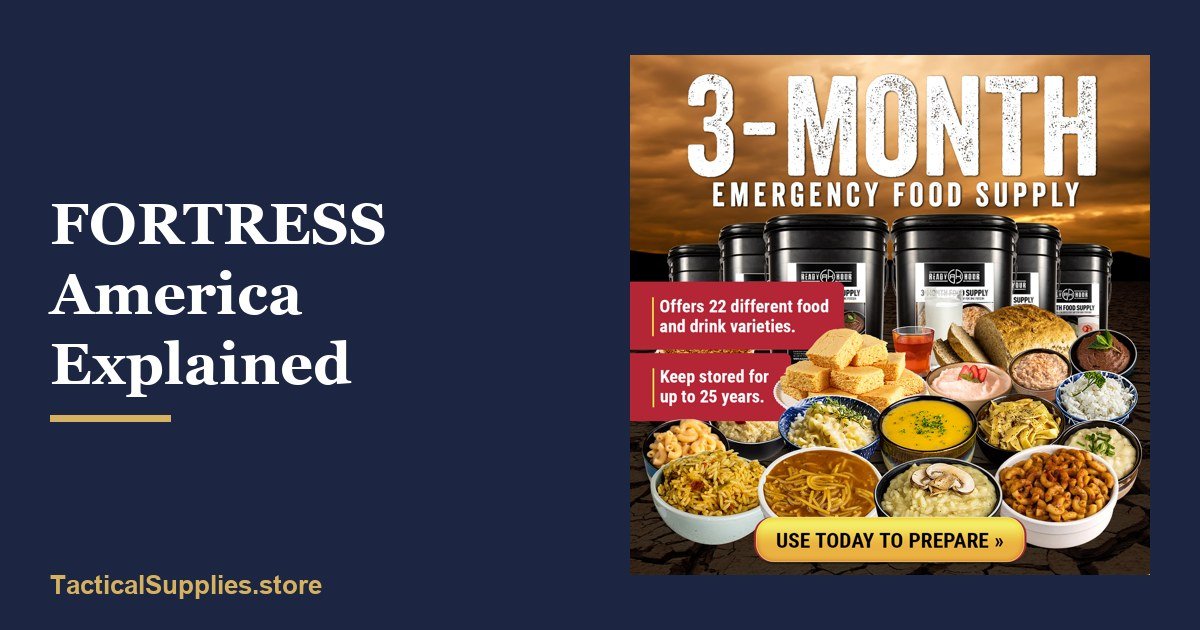
Ready.gov recommends at least a several-day supply of nonperishable food. From there, build in layers. The 4-Week Emergency Food Supply covers one person for four weeks or a family of four for one week. For a deeper cushion, the 3-Month Emergency Food Supply feeds one person for three months or a family of four for three weeks, with a listed shelf life of up to 25 years when stored properly. Our guide on how to build a 3-month emergency food supply shows how to get there step by step.
If you want extra calories and protein built in, the MEGA 3-Month Emergency Food & Protein Supply is designed to provide one person with 2,400+ calories per day for 90 days.
3. Two sources for what matters most: water
The Pentagon wants two supply pathways for critical needs. For a family, water is the obvious one. Ready.gov recommends one gallon per person per day for several days, for drinking and sanitation. Store that, then add a way to make more. The Alexapure Pro Water Filtration System is gravity-powered, so it works without electricity or plumbing. Our emergency water storage guide covers containers and rotation.
4. Hardening: protect the basics
Keep copies of IDs and insurance papers in a waterproof bag, keep some cash on hand, and keep a battery-powered carbon monoxide detector in case you ever need backup heat or a generator.
Get ready for your own 90 days
Top sellers at My Patriot Supply this week.

Shop emergency survival food
One of My Patriot Supply’s two best sellers this week.
Frequently asked questions
What does FORTRESS stand for?
Federal Operations for Resilience, Troop Resources, Energy, Supply, and Survivability.
Is the 90-day requirement confirmed?
Not officially. It comes from Pentagon documents reviewed by Fox News that have not been made public. Snopes rates the reporting “mostly true” because the department spokesperson shared the story but has not explicitly confirmed the 90-day figure.
Does FORTRESS America mean a war is coming?
No official has said that. Hegseth described it as insurance, and Fortune notes neither the U.S. nor British government has said a new war is imminent.
Will FORTRESS America affect power to my home?
There’s no public plan that changes civilian service. Snopes says its effect on civilian preparedness is unclear, so plan for your household the same way you would for any storm.
When does FORTRESS America start?
It was established on September 30, 2026, and a program office was ordered set up in October. There is no public date for bases to meet the reported 90-day standard, and a senior official told Fortune full compliance could take decades.
What does FORTRESS America mean for civilians?
Directly, nothing yet: it is a plan for military bases, not homes. Indirectly, it’s a reminder that a long grid outage is something serious planners prepare for, so it’s worth having a few weeks of food, water and backup power at home.
The bottom line
FORTRESS America is real, the grid-independence goal is on the record, and the 90-day standard is credibly reported but not yet published. The useful lesson for families is the same one the Pentagon is acting on: don’t let everything depend on one fragile system. Start with a few days of food, water and light, then build from there at your own pace.
Sources: Snopes, Fox News, Fortune, The Daily Wire, DefenseScoop, CISA advisory AA24-038A, FERC-NERC February 2021 report, Ready.gov. Product details are from My Patriot Supply product pages as of October 27, 2026.