Disclosure: this post contains affiliate links. If you buy through them, we may earn a commission at no extra cost to you.
Tornadoes give you minutes, not days. When a warning sounds, there’s no time to hunt for shoes, a flashlight or the dog’s leash. A tornado emergency kit kept right in your shelter spot means everything you need is already waiting when you get there.
This guide uses National Weather Service, CDC and Ready.gov guidance to cover the difference between a watch and a warning, where to shelter, what belongs in your tornado emergency kit, and how to stay safe in the hours after the storm passes.
Tornado watch vs tornado warning
These two alerts sound alike, but they ask you to do very different things. Here’s how the National Weather Service defines them:
- Tornado Watch: tornadoes are possible in and near the watch area. Watches usually cover many counties or even several states. This is the time to review your plan, check your supplies and make sure your safe spot is ready.
- Tornado Warning: a tornado has been sighted or indicated by weather radar. Warnings cover a smaller area, roughly a city or small county. Go to your shelter now.
- Tornado Emergency: the National Weather Service’s highest alert level. If one is issued for your area, take cover immediately in the safest place you can reach.
Know how your community sends warnings. The NWS notes that some areas use outdoor sirens, while others rely on media and smartphones. Ready.gov’s basic kit list includes a NOAA Weather Radio with tone alert, which can wake you up when a warning is issued at night. Our guide to the best solar emergency weather radios covers options.
Where to shelter during a tornado
Pick your spot now, before the sky turns dark. According to the NWS and CDC:
- Best: a basement, storm cellar or safe room.
- No basement: an interior room without windows on the lowest floor of a sturdy building, such as a closet, bathroom or hallway.
- Mobile homes: the CDC says not to stay in one during a tornado. Even mobile homes with tie-downs can’t withstand tornado winds. Know in advance where the nearest sturdy shelter is.
- In a vehicle: don’t try to outrun a tornado. If you can’t reach a shelter, the CDC and NWS say to get down in the vehicle and cover your head and neck, or leave it for a low area like a ditch that is clearly lower than the road.
Once you’re there, stay away from windows, doors and outside walls (Ready.gov). Protect your head and neck with your arms, and cover your body with a blanket, sleeping bag or mattress if you can (CDC).
Should you build a safe room?
If you live in tornado country, a safe room is the gold standard. Ready.gov recommends building a safe room using FEMA criteria, or a storm shelter that meets ICC 500 standards. Even if you never build one, choose your best existing room and treat it as your tornado shelter. The NWS suggests regular family drills so everyone knows where to go.
What goes in a tornado emergency kit
Your tornado emergency kit has two jobs. First, protect you for the minutes the storm is overhead. Second, carry you through the hours or days after, when power, water and roads may be out. Keep it in your shelter spot, not in the garage.
For the shelter itself
- Sturdy shoes for everyone. The CDC advises wearing sturdy shoes or boots, long sleeves and gloves when walking on or near debris. You may need them the moment you step out.
- Helmets, if your family chooses to use them. The CDC says helmets can be one part of a home tornado kit, but should never replace proper shelter, and hunting for one in the last seconds can delay you. Store them in the shelter so they’re already there.
- Blankets or sleeping bags to cover your body against flying debris.
- Flashlights or headlamps with extra batteries.
- A NOAA Weather Radio (battery or hand crank).
- A whistle to signal for help (on Ready.gov’s kit list).
- A dust mask to help filter contaminated air (also on the Ready.gov list).
- Your phone, a charger and a backup battery.
For the hours and days after
- Water: at least 1 gallon per person per day for several days (Ready.gov).
- Food that needs no refrigeration and a manual can opener.
- A first aid kit and any prescription medicines. Our home first aid kit guide covers what to include.
- A wrench or pliers to turn off utilities.
- Work gloves for handling debris.
- Copies of IDs and insurance papers in a waterproof bag.
- Pet supplies, including a leash or carrier.
A compact food option for the shelter
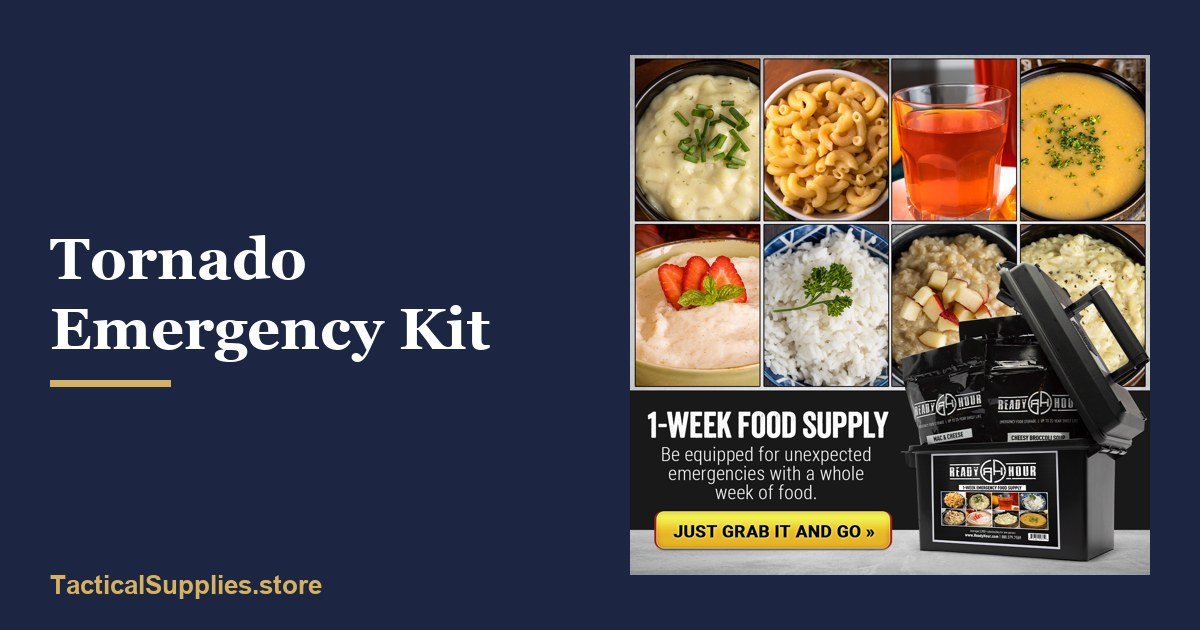
Shelter space is tight, so food that packs small and stores for years works well. The 1-Week Food Supply Ammo Can provides 14,860 calories (2,000+ per day for one person for a week, or two people for 72 hours) in a single durable ammo can measuring 14″ x 7″ x 8 1/2″. It has a shelf life of up to 25 years when stored properly. One thing to plan for: most meals need water and heat, and it takes 2.96 gallons of water to prepare the entire supply.
For a full checklist beyond tornado season, see our 72-hour emergency kit checklist.
After the tornado: staying safe
The danger doesn’t end when the wind stops. Debris, damaged utilities and fuel-burning equipment all carry risks. The CDC’s after-tornado guidance includes:
- Injuries: don’t move seriously injured people unless they’re in immediate danger. Stop bleeding with direct pressure.
- Power lines: stay clear of fallen lines and report them to the electric company.
- Gas: if you smell gas or see a broken line, shut off the main valve from outside, and avoid flames and switches until you’re sure there’s no leak.
- Light: use flashlights, not candles, when the power is out.
- Generators: run them outdoors, at least 20 feet from any window, door or vent, and use a carbon monoxide detector.
- Calls: Ready.gov suggests saving phone calls for emergencies and using texts or social media to reach family.
Safe water after the storm
Damage can disrupt your water supply, so stored water is your first line. If you have to use other water, a gravity filter like the Alexapure Pro Water Filtration System works without electricity, which matters when the power is out. Remember the CDC’s warning, though: water contaminated with fuel or toxic chemicals can’t be made safe by boiling or disinfecting, so follow local officials’ advice. For a longer outage after the storm, our power outage emergency kit guide picks up where this one leaves off.
Tornado emergency kit checklist
- Sturdy shoes, gloves and helmets kept in the shelter
- Blankets or sleeping bags
- Flashlights, headlamps and spare batteries
- NOAA Weather Radio
- Whistle and dust masks
- Phone charger and backup battery
- Water: 1 gallon per person per day
- Non-perishable food, such as a 1-week food supply ammo can, and a can opener
- First aid kit and medicines
- Wrench or pliers for utilities
- Documents, cash and pet supplies
Frequently asked questions
Where should I keep my tornado emergency kit?
In your shelter spot: the basement, safe room or interior room you’ll use during a warning. A tornado emergency kit stored in the garage is no help when you only have minutes to take cover.
Is a bathtub a good place to shelter?
The NWS and CDC guidance is to use a basement, safe room or interior room without windows on the lowest floor. An interior bathroom can fit that description. Cover yourself with a blanket or mattress and protect your head and neck.
Should I open windows before a tornado?
Official guidance from the NWS and Ready.gov is to stay away from windows and get to shelter. Spend those minutes getting your family and your kit to safety, not opening windows.
Do I need a helmet?
The CDC says helmets can be part of a home tornado kit, but they never replace proper shelter. If you use them, keep them in the shelter so no one wastes time looking for one.
The bottom line
A tornado emergency kit is mostly about location and timing. Choose your shelter, stock it with shoes, light, a weather radio, water and food, and practice getting there fast. When the warning comes, all you have to do is move.
Sources: National Weather Service: Watch vs Warning, NWS: During a Tornado, NWS: Tornado Preparedness, Ready.gov (FEMA): Tornadoes, Ready.gov: Build a Kit, CDC: During a Tornado, CDC: After a Tornado, CDC: How to Make Water Safe in an Emergency. Product details are from My Patriot Supply product pages as of October 27, 2026.