Disclosure: this post contains affiliate links. If you buy through them, we may earn a commission at no extra cost to you.
The best emergency lights for power outages are the boring ones: battery flashlights, headlamps and lanterns that are charged, easy to find and safe around kids and pets. Light is the first thing you miss when the power goes out, and it is also the cheapest gap to fill. A good setup takes one afternoon and lasts for years.
Quick pick: keep the lights on for days, not hours
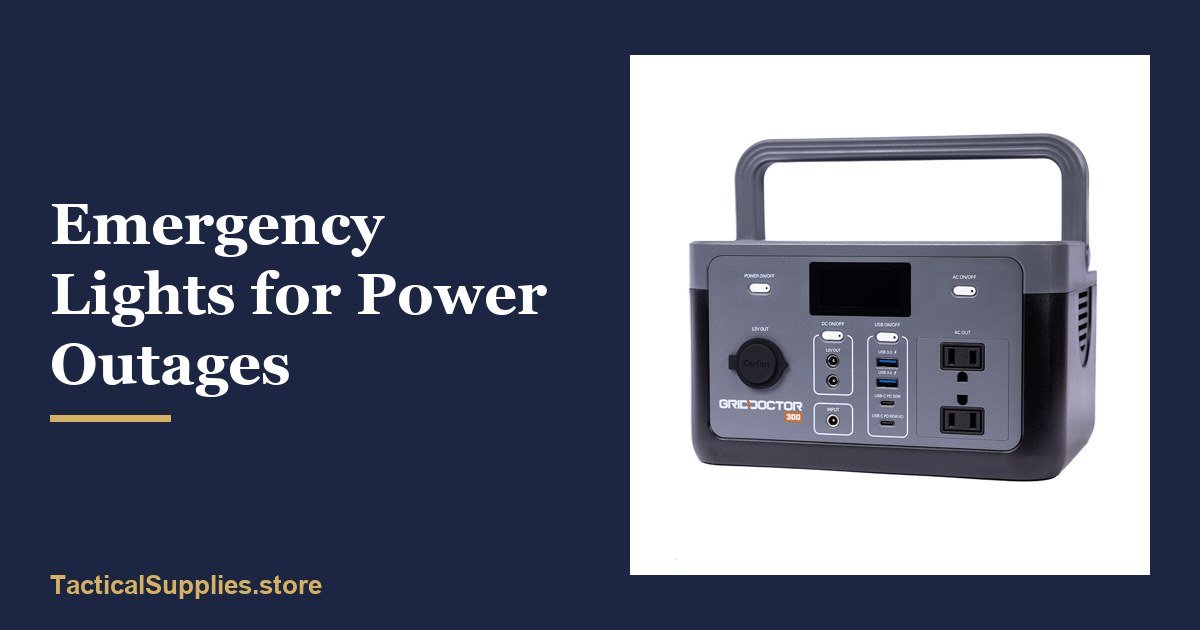
Use: Grid Doctor 300 Solar Generator
Recharges lanterns, headlamps and phones from a 100W solar panel, 9 output ports.
Check today’s price
Use: 1-Week Food Supply Ammo Can
Pairs with your light kit: 2,000+ calories per day for one person for a week.
Check today’s price
This guide covers which kinds of lights to keep, how many you need, where to store them, how to keep them powered through a long outage and why fire safety experts want you to skip the candles.
Why flashlights beat candles
Candles feel cozy, but they are a real fire risk in a dark, stressful house. The U.S. Fire Administration’s advice is simple: “Use flashlights, not candles, if you have a power outage.” The CDC likewise recommends battery-powered flashlights and lanterns rather than candles to lower the risk of fire.
The numbers back that up. According to the National Fire Protection Association, an average of 20 home candle fires are reported each day, more than half start when something that can burn is too close to the flame, and over one-third (36%) start in the bedroom. If you still want candles in your kit, read our guide to emergency candles for power outages and never leave one burning unattended.
The 5 types of emergency lights for power outages
1. Flashlights (one per person)
Ready.gov recommends having flashlights for every household member. LED models are the standard now because they use far less power than old incandescent bulbs, so a set of batteries goes further. Pick models that use the same battery size so your spares fit everything.
2. Headlamps
A headlamp keeps both hands free for cooking, caring for kids, checking the breaker panel or walking a dark stairway. They are the most useful light in the kit for adults who need to get things done.
3. Lanterns for the main room
A flashlight lights a spot. A lantern lights a room. Keep at least one battery or rechargeable LED lantern for the room your family will gather in, and a smaller one for the bathroom.
4. Plug-in and motion-sensor night lights
Some rechargeable night lights stay plugged into an outlet and switch on automatically when power cuts out. Put them in hallways and near stairs so nobody trips in the first few seconds of darkness.
5. Crank and solar lights
Hand-crank and solar lights don’t depend on a supply of batteries, which makes them a good backup for long outages. Many emergency radios include a built-in light and a phone charging port. Our guide to the best hand crank emergency radio covers those combo units.
How many emergency lights for power outages do you need?
A simple rule for a family of four:
- 4 flashlights or headlamps (one per person), kept by each bed
- 1 main lantern for the living area
- 1 small lantern for the bathroom
- 2 to 3 automatic night lights for halls and stairs
- 1 crank or solar light as a backup
- Spare batteries for at least 3 days of use
Store one flashlight in the same spot in every bedroom so nobody has to search, and keep the rest of your light kit together with your other outage supplies so you can find it in the dark.
Keeping emergency lights for power outages charged for days
Batteries run out. If you live where outages last days, plan a way to recharge. Ready.gov suggests making a list of everything that needs electricity and planning backup power for it, such as a portable charger or power bank.
For a bigger cushion, the Grid Doctor 300 Solar Generator is built for exactly this kind of load: charging phones, tablets and laptops, and powering small appliances and lighting. It has a 320Wh LiFePO4 battery, 300W pure sine wave output and 9 output ports, including USB-A and USB-C, so you can recharge several lanterns and headlamps at once. The included 100W solar panel lets you top it up during the day. It is not designed for full-size refrigerators, microwaves or space heaters.
If you also need to keep a fridge, medical equipment or other large loads running, the Grid Doctor 3300 Solar Generator has 3300W continuous output and a 2048Wh battery, sized for multi-day outages where refrigeration, lights and communications matter. For help choosing between the two, see our Grid Doctor 300 vs 3300 comparison.
Light safety during a power outage
Even the best emergency lights for power outages only help if they are used safely. Four habits matter most:
- Skip fuel lanterns indoors. Camp lanterns that burn fuel create a fire risk and, like any fuel-burning device, can produce carbon monoxide. Keep battery-backup carbon monoxide detectors on every level of your home, as Ready.gov recommends.
- Leave one light switch on. Turn off or unplug other appliances and electronics, because power can return with surges. A single light on tells you when it is back.
- Keep lights where kids can reach them. A child with their own flashlight never needs to go looking for matches or candles.
- Check batteries twice a year. Swap in fresh spares when you change your clocks.
Build the rest of your outage kit
Lights are step one. Food is the next gap that catches families out, because a refrigerator only keeps food cold for about four hours without power, per Ready.gov. The 1-Week Food Supply Ammo Can covers one person for a week with 2,000+ calories per day, has a shelf life of up to 25 years when stored properly and stores in a 14″ x 7″ x 8 1/2″ ammo can that fits on the same shelf as your lights. For the full list, see our power outage emergency kit.
Frequently asked questions
What are the safest emergency lights for power outages?
Battery-powered or rechargeable LED flashlights, headlamps and lanterns. The U.S. Fire Administration and the CDC both recommend them over candles because they don’t create a fire risk.
Are candles OK during a blackout?
Fire safety agencies advise using flashlights instead. If you do use candles, keep them away from anything that can burn and never leave them unattended.
How do I keep lights charged in a multi-day outage?
Keep spare batteries, a charged power bank and at least one crank or solar light. A small solar generator can recharge several lights and phones every day.
Where should I store emergency lights for power outages?
One flashlight by each bed and the rest of the kit in one known spot, such as a kitchen drawer or hall closet, so anyone can find it in the dark.
The bottom line
You don’t need fancy gear. A flashlight for each person, a lantern for the main room, a few automatic night lights and a way to recharge cover almost every outage. Pick good emergency lights for power outages this week, store them where you can find them in the dark, and leave the candles for dinner parties.
Sources: U.S. Fire Administration: Candle Fire Safety, NFPA: Safety with Candles, CDC: Protect Yourself During a Power Outage, Ready.gov: Power Outages. Product details are from My Patriot Supply product pages as of October 27, 2026.