Disclosure: this post contains affiliate links. If you buy through them, we may earn a commission at no extra cost to you.
Picking a generator for power outage backup starts with one honest question: what do you actually need to keep running? A phone charger and a lamp is a very different job from a refrigerator, a well pump and a furnace blower. Get that answer first and the right size, fuel and budget fall into place.
Quick pick: solar generators with no engine and no exhaust
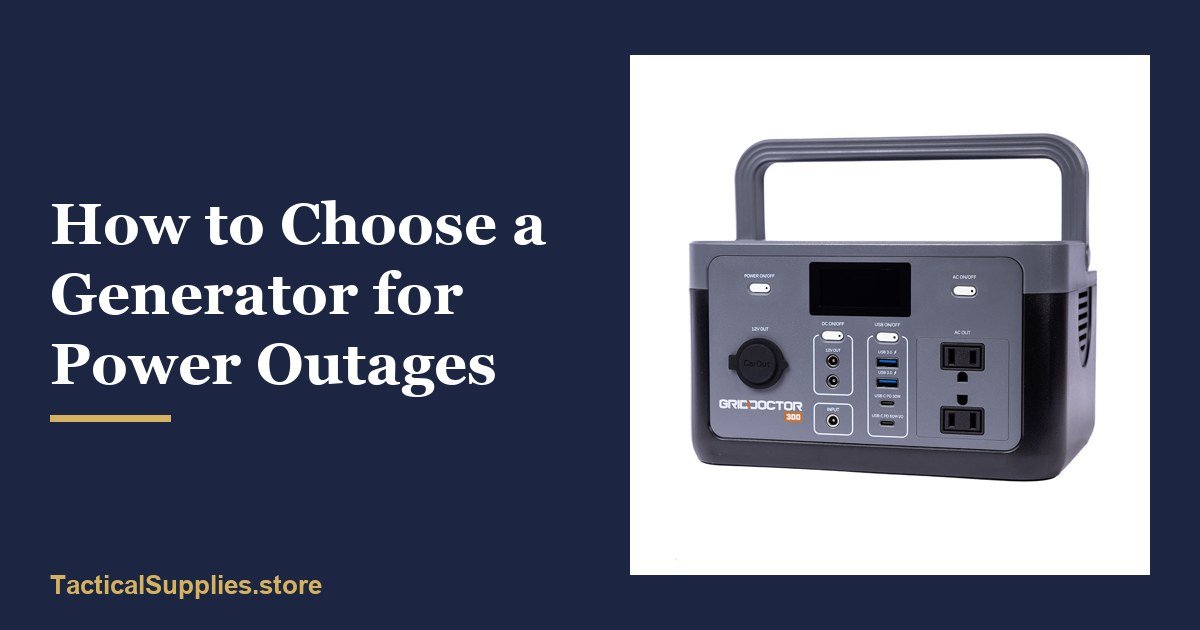
Small loads: Grid Doctor 300 Solar Generator
Phones, lights, a CPAP or a fan. 320Wh battery, 100W solar panel, under 9 pounds.
Check today’s price
Bigger loads: Grid Doctor 3300 Solar Generator
3,300W output, a 2,048Wh battery and a 200W solar panel for longer outages.
Check today’s price
This guide walks through sizing, the gas vs. battery decision, the safety rules from the CDC, CPSC and OSHA, and the two solar generators we link to and who each one fits.
Why more families are shopping for a generator for power outages
On September 30, the Pentagon announced FORTRESS America, an initiative to help major U.S. bases run on their own power. According to Pentagon documents reviewed by Fox News, major bases in the continental U.S. are being asked to plan to sustain essential operations for at least 90 days on their own. The Pentagon has not released the memo publicly, and Snopes rates the reporting “mostly true.” Our FORTRESS America explainer covers the details.
You do not need to expect a 90-day blackout to learn from that. Storms and ice take down power lines every winter, and a few days of backup power at home is a sensible plan for any family.
Step 1: List what has to stay on
Before you shop for a generator for power outage use, write down every device you would want running and its wattage, which is usually printed on a label or in the manual. Group them like this:
- Must have: phones, a radio, lights, medical devices such as a CPAP, the internet router.
- Important: the refrigerator and freezer, a sump pump, a well pump.
- Nice to have: microwave, coffee maker, TV.
Food is often the biggest money at stake. FoodSafety.gov says a refrigerator keeps food safe for about 4 hours without power, and a full freezer holds its temperature for about 48 hours if you keep the door closed. Our guide to how long food lasts in the fridge without power covers the details.
Ready.gov also advises talking to your medical provider about a power plan for any electricity-dependent medical device, so add that conversation to your list.
Step 2: Choose gas or battery
Gas and dual-fuel portable generators
These deliver a lot of power for the money and can run as long as you have fuel. The tradeoffs are noise, fuel storage, maintenance and, above all, carbon monoxide. They must run outdoors, which means hauling them out in the storm you are trying to wait out.
Battery “solar generators”
A solar generator is a large battery with an inverter and outlets, recharged from solar panels, a wall outlet or a car. There is no engine, so there is no exhaust, no fuel to store and very little noise. The limit is stored energy: once the battery is drained, you are waiting on the sun or the grid. Read our Grid Doctor 300 vs 3300 comparison for a side-by-side.
Step 3: Match the size to the job
Two numbers matter on any battery-based generator for power outage backup. Output (watts) is how much it can power at once. Capacity (watt-hours) is how long it can keep going. Here is how the two units we link to compare, using specs from My Patriot Supply.
Small loads: Grid Doctor 300
The Grid Doctor 300 Solar Generator has a 320Wh LiFePO4 battery and 300W continuous output (600W surge), with 9 output ports and a 100W solar panel included. It weighs about 8.6 pounds. The maker lists it for phones, laptops, lights, routers, radios and CPAP machines. It is not designed for full-size refrigerators, microwaves, sump pumps or space heaters, so treat it as a device-charging station, not a whole-home backup.
Real household loads: Grid Doctor 3300
The Grid Doctor 3300 Solar Generator is the one sized for multi-day outages where refrigeration matters. It has a 2048Wh LiFePO4 battery, 3300W continuous output (6600W surge), four standard 120V outlets plus a 30A RV outlet, and a 200W waterproof solar panel. Capacity expands to 16,384Wh with expansion batteries, and it accepts up to 1000W of solar input. It also includes what the maker calls EMP Intercept Technology. Know its limits: it weighs 57.2 pounds, and the maker says it is not meant for 240V loads such as central HVAC or a full home panel. Our post on a solar generator for a refrigerator walks through the fridge math.
7 safety rules for any generator for power outage use
The CPSC estimates that portable generators have been linked to 796 non-fire CO poisoning deaths since 2010. Most of these rules exist because of that number.
- Run fuel generators outdoors only. The CDC says to keep them more than 20 feet from windows, doors and vents, and never inside a home, basement or garage, even with doors open.
- Point the exhaust away from the house. The CPSC also warns against running one on a porch or in a carport.
- Look for CO safety features. The CPSC recommends models with a CO shut-off and points to the PGMA G300-2018 and UL 2201 standards.
- Use battery CO alarms inside. The CDC says to have a battery-powered or battery-backup CO detector in the home whenever a generator is running.
- Never plug a generator into your home’s wiring. OSHA says not to connect a portable generator to a structure’s electrical system unless it goes through a properly installed transfer switch, put in by a qualified electrician. Improper connections can shock and kill utility workers.
- Use heavy-duty, grounded extension cords. The CDC suggests a cord more than 20 feet long so the generator can sit at a safe distance.
- Refuel only when cool, and keep it dry. Ready.gov warns that fuel spilled on hot engine parts can ignite and that touching a wet generator can cause shock.
Plan for heat and food, too
A generator for power outage use rarely covers everything. Many units cannot run an electric space heater for long, so have a non-electric option. The VESTA Self-Powered Indoor Space Heater and Stove warms up to 200 square feet on canned heat and doubles as a stove, designed for indoor use with adequate ventilation.
For food that does not depend on the fridge, the 1-Week Food Supply Ammo Can provides 2,000+ calories a day for one person for a week and stores for up to 25 years. See the full list in our power outage emergency kit guide.
For more on this, see our guide: Kerosene Heater Safety Guide.
Related reading: What to Do During a Power Outage.
For more on this, see our guide: Best Portable Power Station for Emergencies 2026.
Frequently asked questions
What size generator for power outage backup do I need?
Add up the running watts of everything you want on at the same time, then leave headroom for startup surges from motors like fridge compressors. For phones, lights and a CPAP, a 300W unit can work. For a refrigerator plus other essentials, look at units in the 3000W range with 2000Wh or more of storage.
Can I run a generator in my garage with the door open?
No. The CDC says never to use a generator inside a home or garage, even if doors and windows are open. Keep it outdoors and more than 20 feet from openings.
Can I plug my generator into a wall outlet?
No. OSHA says not to connect a generator to a building’s wiring without a properly installed transfer switch. Plug appliances directly into the generator or use a transfer switch installed by a qualified electrician.
Are solar generators safe to use indoors?
Battery units have no engine, so they produce no exhaust. Follow the maker’s instructions on placement, ventilation and charging.
The bottom line
The best generator for power outage backup is the one sized to your real must-have list. Write the list, pick gas or battery, match the watts and watt-hours, and follow the CO and wiring rules without exception. Then cover heat and food separately so one machine is not carrying your whole plan.
Sources: CDC: Protect Yourself During a Power Outage, CDC: Carbon Monoxide Poisoning Basics, CPSC: Stay Safe While Staying Warm, OSHA: Grounding Requirements for Portable Generators, Ready.gov: Power Outages, FoodSafety.gov, Fox News, Snopes, DefenseScoop. Product details are from My Patriot Supply product pages as of October 27, 2026.