Disclosure: this post contains affiliate links. If you buy through them, we may earn a commission at no extra cost to you.
Rolling blackouts are planned, temporary power cuts that a grid operator orders when demand for electricity gets ahead of supply. Instead of letting the whole system fail, utilities switch off one neighborhood at a time, then rotate to the next. They are usually short, but they can come with little warning, and in a bad event they can stretch much longer than planned.
Quick pick: ride out a rotating outage
Use: 1-Week Food Supply Ammo Can
2,000+ calories per day for one person for a week, no fridge needed.
Check today’s price
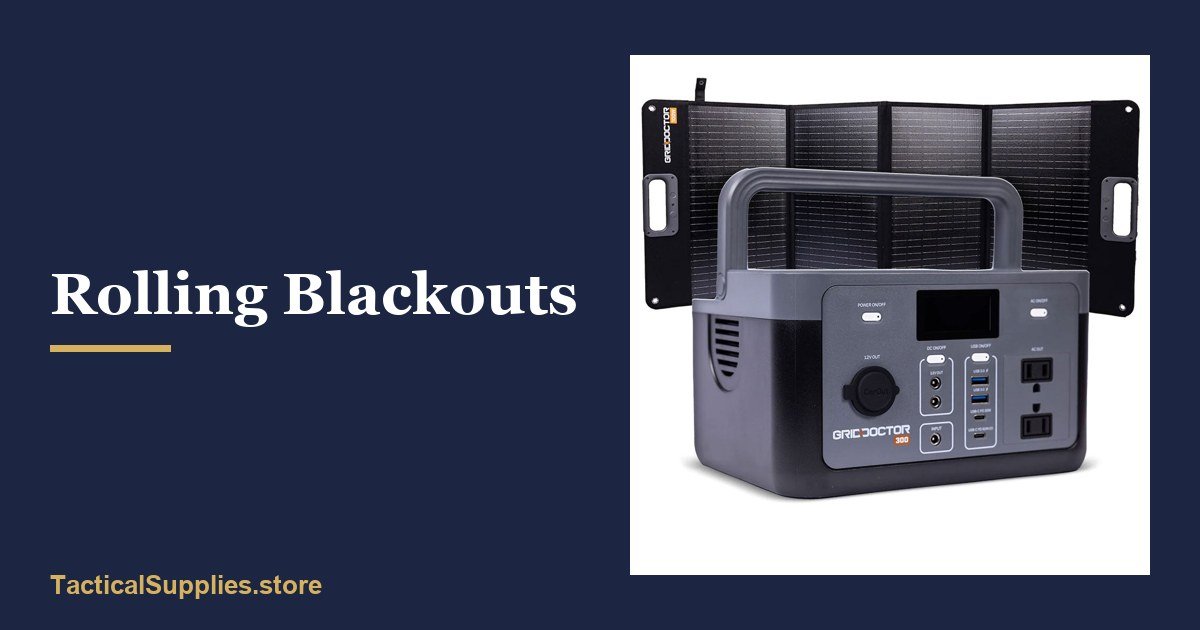
Use: Grid Doctor 300 Solar Generator
320Wh battery plus a 100W solar panel for phones, lights, routers and CPAP machines.
Check today’s price
This guide explains how rotating outages work, why they happen, what past events looked like, and a short plan to get your household ready before the next one.
What are rolling blackouts?
Grid operators have to keep the supply of electricity and the demand for it in balance every second. When power plants trip offline in extreme cold, or a heat wave pushes air conditioning demand past what the grid can deliver, the operator runs out of safe options. The last step is to deliberately cut part of the demand. Engineers call this “load shed.” Most people call it rolling blackouts or rotating outages.
Texas grid operator ERCOT describes rotating outages as controlled, temporary interruptions that “primarily affect residential neighborhoods and small businesses.” In its own words, they are typically “limited to 10-45 minutes before being rotated to a different neighborhood,” and they do not typically include critical-need customers such as hospitals.
The warning steps before the lights go out
Planned outages rarely come out of nowhere. Operators usually move through a series of steps first:
- Conservation appeal: the operator asks the public to cut back on electricity use.
- Energy emergency alerts: the operator uses every available power plant, imports power from neighboring grids and calls on customers who are paid to reduce use.
- Load shed: if reserves keep falling, utilities are ordered to start rotating outages.
Our guide to power grid failure covers the bigger picture, including what happens when a grid problem spreads beyond planned cuts.
Real examples of rolling blackouts in the U.S.
California, August 2020
During a West-wide extreme heat wave in August 2020, California’s grid operator was forced to order rotating outages. The final report from the California Independent System Operator, the California Public Utilities Commission and the California Energy Commission found three main causes: extreme weather, gaps in resource planning and market practices. No single failure caused it.
Texas, February 2021
Winter Storm Uri is the example most people remember. Extreme cold knocked a huge amount of generation offline at the same time demand for heat spiked, and grid operators ordered outages across Texas. Many homes were dark for far longer than the usual 10 to 45 minutes, because there was not enough power to rotate. That is the key lesson: rolling blackouts are designed to be short, but a severe enough shortage can turn them into a multi-day outage.
Why the risk is growing
The U.S. Energy Information Administration reports that the average electricity customer had 11 hours of power interruptions in 2024, and South Carolina customers averaged nearly 53 hours. Most of that came from major storms rather than planned cuts, but the point stands. Outages of every kind are part of normal life now, and the same supplies cover them all. See how long a power outage can last for the full federal numbers.
How to prepare for rolling blackouts: 7 easy steps
1. Sign up for alerts
Register for outage and conservation alerts from your utility and, if it offers them, your regional grid operator. A conservation appeal is your cue to charge devices, fill water containers and pre-cool or pre-heat your home while power is still on.
2. Keep phones and lights charged
Ready.gov recommends having flashlights for every household member and a backup power source such as a portable charger or power bank. Keep at least one bank charged at all times. For more than a phone, the Grid Doctor 300 Solar Generator pairs a 320Wh LiFePO4 battery and 300W pure sine wave output with a 100W solar panel. It is built for phones, laptops, routers, lights, radios and CPAP machines, not for full-size refrigerators, microwaves, sump pumps or space heaters.
3. Protect your fridge
Keep the doors closed. Ready.gov says a refrigerator keeps food cold for about four hours, and a full freezer for about 48 hours. A short rotating outage won’t spoil anything if you leave the doors shut. If the outage runs long, follow our guide on how long food lasts in the fridge without power.
4. Store food that needs no fridge
Canned goods and crackers cover a few hours. For a cushion that covers a multi-day shortage, the 1-Week Food Supply Ammo Can provides 14,860 calories (2,000+ per day for one person for a week, or two people for 72 hours), has a shelf life of up to 25 years when stored properly, and needs 2.96 gallons of water to prepare everything. For a family, the 4-Week Emergency Food Supply feeds one person for four weeks or a family of four for one week.
5. Plan for medical devices and medicine
Ready.gov advises asking your medical provider for a power outage plan for any electric medical device or refrigerated medicine. Rotating outages are when this matters most, because they hit residential neighborhoods first.
6. Stay safe with heat, cooling and generators
Never use a gas stove or oven to heat your home. Run fuel generators only outdoors, at least 20 feet from windows, doors and attached garages, and install battery-backup carbon monoxide detectors on every level of your home. In extreme heat or cold, go to a community cooling or warming location.
7. Size up if you need whole-room backup
If someone at home depends on refrigeration, medical equipment or a well pump, a larger battery system is worth a look. The Grid Doctor 3300 Solar Generator has 3300W continuous output (6600W surge), a 2048Wh LiFePO4 battery expandable to 16,384Wh, and is built for multi-hour to multi-day outages where refrigeration, lights and communications matter. It does not provide 240V output for large HVAC systems or full-home panels.
Rolling blackouts checklist
- Utility and grid operator alerts turned on
- Flashlights for every person, plus spare batteries
- Charged power banks or a small solar generator
- Food that needs no fridge for at least 3 days
- 1 gallon of water per person per day
- Battery-backup carbon monoxide detectors
- Medical device and medicine plan
- Surge protection: unplug electronics when power cuts out
For the full list, see our power outage emergency kit guide.
Frequently asked questions
How long do rolling blackouts last?
ERCOT says rotating outages are typically limited to 10 to 45 minutes per neighborhood before moving on. In a severe shortage, such as Texas in February 2021, there may not be enough power to rotate, and outages can last much longer.
Why do utilities use rolling blackouts instead of fixing the problem?
When demand outruns supply, cutting some load on purpose keeps the whole grid from becoming unstable and failing. A controlled short outage for some is far better than an uncontrolled blackout for everyone.
Will I get a warning before a rotating outage?
Usually there are public conservation appeals and emergency alerts first, but the outage itself can start with little notice. Treat any conservation appeal as your signal to charge up and get ready.
What should I unplug during a rotating outage?
Ready.gov recommends turning off or unplugging appliances and electronics, because power can come back with surges or spikes that damage them. Leave one light on so you know when power returns.
The bottom line
Rolling blackouts are meant to be short, controlled and rare, but the past few years show they can arrive in a heat wave or deep freeze and sometimes last much longer than planned. Sign up for alerts, keep lights and phones charged, protect your fridge and keep a few days of food and water on hand. That small effort turns a stressful night into a minor inconvenience.
Sources: ERCOT: Power emergency and rotating outages (2011), CPUC: Final report on causes of August 2020 rotating outages, EIA: Power interruptions in 2024, Ready.gov: Power Outages, Ready.gov: Build a Kit, CDC: Protect Yourself During a Power Outage. Product details are from My Patriot Supply product pages as of October 27, 2026.