Disclosure: this post contains affiliate links. If you buy through them, we may earn a commission at no extra cost to you.
Earthquakes don’t come with a forecast. One moment the house is quiet, the next the shelves are coming down. That’s why an emergency kit for earthquake country has to be ready before the first jolt, along with a home that’s been secured and a family that knows exactly what to do when the shaking starts.
This guide uses Ready.gov (FEMA), CDC and Earthquake Country Alliance guidance to cover what to do during shaking, how to secure your home, what to pack, and how to handle gas and water afterward.
During the shaking: Drop, Cover, and Hold On
Ready.gov and the Earthquake Country Alliance agree on the core move:
- Drop where you are onto your hands and knees, before the earthquake knocks you down.
- Cover your head and neck with one arm and hand. Get under a sturdy table or desk if one is close. If not, get down next to an interior wall, away from windows.
- Hold On until the shaking stops.
Just as important is what not to do. The Earthquake Country Alliance says don’t run outside or to other rooms during shaking, and don’t stand in a doorway; in modern homes, doorways are no stronger than any other part of the house. It also calls the so-called “triangle of life” advice potentially life-threatening.
- In bed: stay there and protect your head and neck with a pillow.
- In a wheelchair: lock your wheels, then cover your head and neck and hold on (Ready.gov).
- Driving: pull over, stop and set the parking brake.
- Outdoors: stay outside, in an open area away from buildings, trees, streetlights and power lines.
Ready.gov also suggests signing up for USGS earthquake alerts and ShakeAlert, which can notify you before strong shaking reaches you.
Secure your home before the next quake
The first of the Earthquake Country Alliance’s Seven Steps to Earthquake Safety is “Secure Your Space,” and it’s the cheapest step on the list. It also protects the emergency kit for earthquake recovery you’re about to build, because supplies buried under a fallen bookcase don’t help anyone. Ready.gov recommends securing heavy items like bookcases, refrigerators, water heaters and televisions, and storing heavy or breakable objects on low shelves.
- Anchor tall bookcases and dressers to the wall.
- Strap the water heater. That tank is also an emergency water source (more below), so it’s worth protecting.
- Move heavy items off high shelves, especially above beds and couches.
- Learn where your gas and water shutoff valves are, and keep a wrench nearby.
Ready.gov also points out that standard homeowner’s insurance policies don’t cover earthquake damage, so consider whether an earthquake policy makes sense for your home.
What goes in an emergency kit for earthquake country
The Earthquake Country Alliance recommends thinking in three layers: a small bag by every bed, a go-bag for home and car, and larger household supplies.
1. An under-bed bag for every bed
An earthquake can hit while you’re asleep, and shoes and glasses left on the floor can get scattered or buried under broken glass. The Alliance suggests keeping a small bag attached to each bed with:
- Sturdy shoes and socks
- Glasses or contacts
- A flashlight or headlamp
- A dust mask
- A whistle
- Work gloves
2. Go-bags for home and car
A go-bag should carry you for about 3 days if you have to leave home. The Alliance lists bottled water, medications, first aid supplies, sturdy shoes, copies of ID, a whistle and a working flashlight with extra batteries or light sticks. Our home first aid kit guide can help you stock the medical side.
3. Household supplies
This is the heart of your emergency kit for earthquake recovery. The Alliance recommends supplies for at least 3 days and ideally 2 weeks, kept in a large, watertight container that’s easy to move.
- Water: at least 1 gallon per person per day.
- Food: canned and packaged foods, plus a manual can opener.
- Tools: a wrench to shut off gas and water.
- Light and news: flashlights and a portable radio.
- Warmth: blankets or sleeping bags.
- Safety: a fire extinguisher and a whistle (Ready.gov).
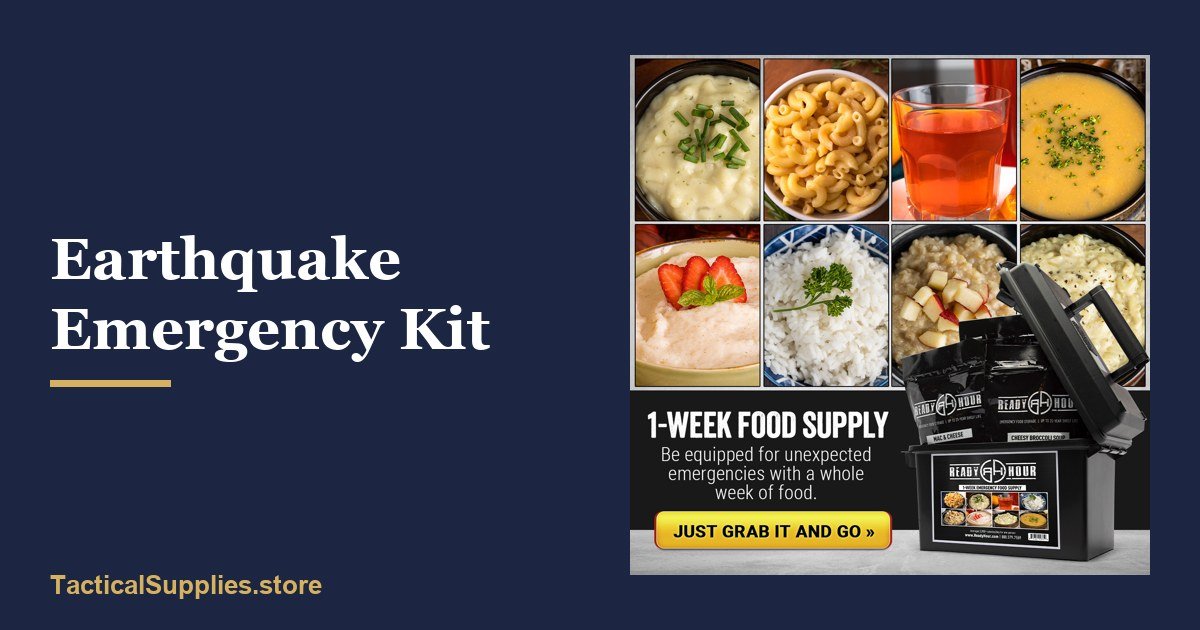
Long-shelf-life food makes it easier to stretch an emergency kit for earthquake recovery to the full 2 weeks. The 1-Week Food Supply Ammo Can provides 14,860 calories (2,000+ per day for one person for a week) with a shelf life of up to 25 years when stored properly, in a sturdy ammo can that also works as a go-bag food supply. For a household, the 4-Week Emergency Food Supply feeds one person for four weeks or a family of four for one week, in two stackable, water-resistant buckets. Both need water to prepare: 2.96 gallons and 9.14 gallons for each full supply, respectively.
Live in California? Our California earthquake emergency food guide goes deeper on the food side.
Whatever goes into your earthquake emergency kit, keep it fresh. The Alliance recommends checking it and replacing water, food, medications and batteries on a yearly basis.
After the shaking: gas, water and aftershocks
Aftershocks
This is when your emergency kit for earthquake recovery earns its place. Ready.gov says to expect aftershocks after the main shock, and to Drop, Cover, and Hold On again whenever you feel one. Don’t go back into damaged buildings. Put on sturdy shoes and work gloves before walking through broken glass and debris (Earthquake Country Alliance).
Gas
Don’t shut off the gas automatically. The Earthquake Country Alliance says to turn off the main gas valve only if you suspect a leak, such as a gas smell, a hissing sound, broken pipes or a meter spinning quickly. Once it’s off, only the gas company can turn it back on after checking for leaks. Use flashlights and battery lights, not candles or matches.
With the gas off, the kitchen stove may be out of action for a while. The VESTA Self-Powered Indoor Space Heater & Stove heats and cooks with no electricity or propane, using InstaFire 6-Hour Canned Heat+, and is designed for indoor use with adequate ventilation. Never use it while a gas leak is suspected.
Water
Broken pipes can cut off or contaminate your tap water. The CDC lists safe sources already inside your home: the tank of your tap water heater (not a radiator or boiler tank), melted ice made from clean water, and liquid from canned fruits and vegetables. It also notes you may need to close your main water valve to keep contaminated water out of your pipes.
If you need to make more water, a gravity filter like the Alexapure Pro Water Filtration System works without electricity or plumbing. The CDC is clear, though, that water contaminated with fuel or toxic chemicals can’t be made safe by boiling or disinfecting, so follow local health officials’ advice.
Power
A strong quake can also bring down power lines and leave you without electricity. Our power outage emergency kit guide covers light, heat and charging when the grid is down.
Frequently asked questions
What is the most important item in an emergency kit for earthquake safety?
Water, followed closely by sturdy shoes by the bed. Ready.gov warns of leaking water and gas lines after a quake, and broken glass makes bare feet a real hazard. Start with those two and build out from there.
Should I stand in a doorway during an earthquake?
No. The Earthquake Country Alliance says doorways in modern homes are no stronger than any other part of the house. Drop, Cover, and Hold On under a sturdy table instead.
Should I turn off my gas after an earthquake?
Only if you suspect a leak, according to the Earthquake Country Alliance. Once it’s off, only the gas company can turn it back on after checking for leaks.
How much water should I store for an earthquake?
At least 1 gallon per person per day, for at least 3 days and ideally 2 weeks. For a family of four, that’s 12 gallons for 3 days or 56 gallons for 2 weeks.
The bottom line
You can’t predict an earthquake, but you can decide how it goes for your family. Secure your space, practice Drop, Cover, and Hold On, and keep an emergency kit for earthquake recovery with at least 3 days (ideally 2 weeks) of water and food. The time to prepare is while the ground is still.
Sources: Ready.gov (FEMA): Earthquakes, Earthquake Country Alliance: Drop, Cover, and Hold On, Earthquake Country Alliance: Seven Steps, ECA: Organize Disaster Supplies, ECA: Improve Safety, CDC: How to Find Clean Water in an Emergency, CDC: How to Make Water Safe in an Emergency. Product details are from My Patriot Supply product pages as of October 27, 2026.