Disclosure: this post contains affiliate links. If you buy through them, we may earn a commission at no extra cost to you.
Emergency power for sump pump protection matters because the storms that flood basements are the same storms that knock out electricity. FEMA warns that a basement can flood when the primary pump stops working or when the power goes out. If your pump runs on house power alone, you are one outage away from standing water. The good news is that you have several solid backup options, from simple battery pumps to a generator or a large solar battery system.
Quick pick: keep the pump running when the grid doesn’t
Use: Grid Doctor 3300 Solar Generator
3300W continuous (6600W surge) output and four standard 120V outlets.
Check today’s price
Use: Alexapure Pro Water Filtration System
Gravity-powered filter for when storms make tap water unsafe, no electricity needed.
Check today’s price
This guide compares the main ways to get emergency power for sump pump systems, shows you how to size a backup from the label on your pump, and covers the safety and insurance details most homeowners miss.
Why sump pumps fail during outages
A standard sump pump is an electric motor with a float switch. When groundwater fills the pit, the float rises and the pump turns on. No electricity means no pumping, and heavy rain can fill a pit quickly. FEMA’s urban flooding guidance also points out that sump pumps are not designed to handle large amounts of water, so even a working pump can be overwhelmed in a bad storm.
Outages are not rare. The U.S. Energy Information Administration reports that the average electricity customer had 11 hours of power interruptions in 2024, mostly from major storms. Our guide to how long a power outage can last breaks down the numbers.
4 options for emergency power for sump pump systems
1. Battery backup sump pump
This is a second pump with its own battery, installed in the same pit. FEMA describes a battery backup pump as an inexpensive safeguard against basement flooding: when the water in the sump reaches its float switch, the backup goes to work. FloodSmart, the federal flood insurance site, also recommends a battery-operated backup pump in case the power goes out.
- Pros: automatic, works when nobody is home, also covers a failed primary pump.
- Cons: limited run time, and the battery needs checking and eventual replacement.
2. Water-powered backup pump
Some homes on city water can use a backup pump that runs on municipal water pressure instead of electricity. It needs adequate water pressure and proper backflow protection, and local plumbing codes vary, so this is a job for a licensed plumber. It is not an option for most homes on a private well, because the well pump stops when the power does.
3. Portable fuel generator
A generator can run your existing pump for as long as you have fuel. Ready.gov says to run generators only outdoors, at least 20 feet from windows, doors and attached garages, keep them dry and connect appliances with heavy-duty extension cords. You also need someone home to start it, refuel it and keep watch. For sizing and safety details, see our guide on choosing a generator for power outages.
4. Solar generator (large battery system)
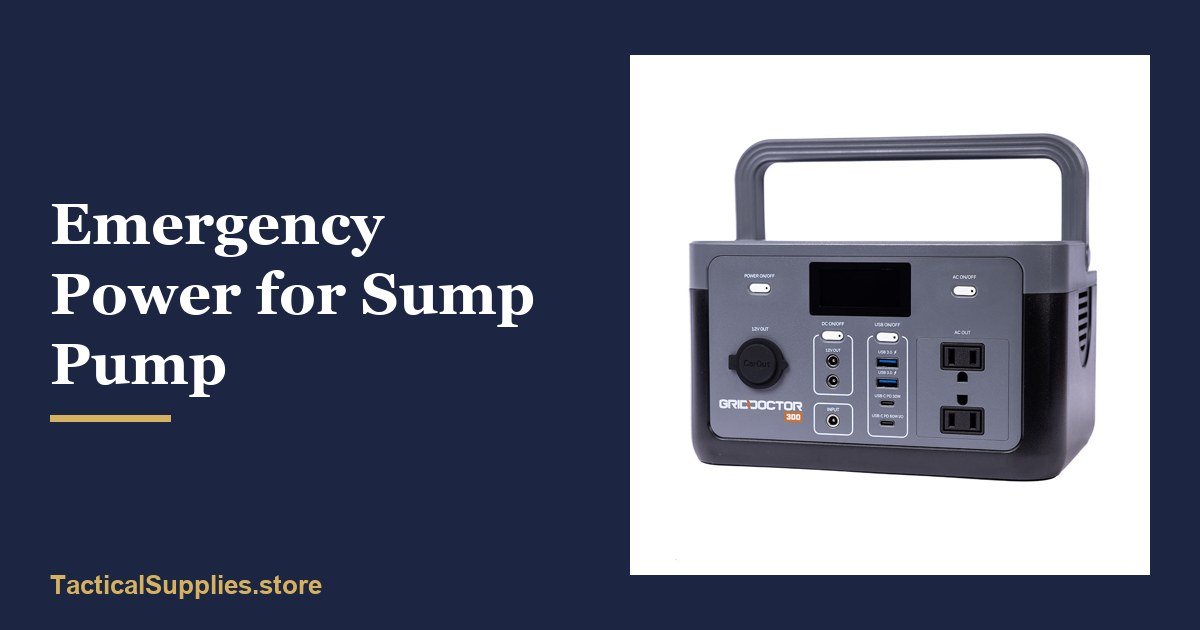
A large battery system gives you generator-style power with no fuel to store and no engine exhaust. The key is size. Small units won’t do it: the maker of the Grid Doctor 300 says plainly that it is not meant for sump pumps.
The Grid Doctor 3300 Solar Generator is the one sized for real household loads. It offers 3300W continuous output with 6600W surge, a 2048Wh LiFePO4 battery expandable to 16,384Wh with up to 7 expansion batteries, and four standard 120V/20A outlets. It recharges from a wall outlet, a vehicle or up to 1000W of solar input, so you can top it up during a long outage. It does not provide 240V output, so check your pump’s voltage first.
How to size emergency power for sump pump use
Your pump’s label tells you most of what you need. Look for watts, or volts and amps.
- Find running watts. If the label shows amps, multiply by volts. A pump rated 10 amps at 120 volts draws about 1,200 watts while running.
- Allow for startup. Electric motors pull extra power for a moment when they start. Make sure your backup’s surge rating covers it.
- Estimate how often it runs. Time your pump during a heavy rain. A pump that runs 15 minutes out of every hour uses a quarter of its running watts per hour.
- Do the math. In that example, 1,200 watts for 15 minutes each hour is about 300 watt-hours per hour. A 2048Wh battery would cover roughly 6 hours of that duty cycle before inverter losses, and less if the pump runs more often.
That example shows why the most reliable emergency power for sump pump setups often combine options: a battery backup pump for automatic protection, plus a larger battery system or generator they can recharge or refuel during a long storm. Our Grid Doctor 300 vs 3300 comparison explains the difference between small and large systems.
Sump pump outage checklist
Emergency power for sump pump systems only works if the rest of the setup is ready too:
- Test your pump before storm season by pouring water into the pit until the float rises.
- Add a water alarm. FloodSmart says a working sump pump and a water alarm can minimize flood damage in your basement.
- Install a check valve or backflow valve where needed. FEMA notes they can become jammed open by debris, so inspect them.
- Keep the discharge line clear and pointed away from the foundation.
- Charge your backup battery or solar generator when a storm is in the forecast.
- Keep fuel stored safely if you rely on a generator.
- Put battery-backup carbon monoxide detectors on every level of your home, as Ready.gov recommends.
Check your flood insurance too
Many homeowners assume insurance covers a flooded basement. The National Flood Insurance Program’s standard policy excludes water that overflows from a sump pump unless a flood in the area is the direct cause, and FEMA describes basement coverage as limited. Ask your agent what your policy covers, and treat emergency power for sump pump backup as cheaper protection than an uncovered claim.
Plan for the rest of the storm
The storm that kills your pump can also affect your water supply. If you are told tap water is unsafe, the Alexapure Pro Water Filtration System is gravity-powered, so it filters without electricity or plumbing, and it has 2.5-gallon chambers. For phones, lights and a CPAP machine during the same outage, the Grid Doctor 300 Solar Generator handles small loads with a 320Wh battery and a 100W solar panel. The full list is in our power outage emergency kit guide.
Frequently asked questions
What is the cheapest emergency power for sump pump protection?
For most homes it is a battery backup sump pump. FEMA calls it an inexpensive safeguard, and it switches on automatically even when you are away.
Can a solar generator run a sump pump?
A large one can, if its continuous and surge ratings cover your pump and its battery is big enough for the hours you need. Small portable units such as the Grid Doctor 300 are not designed for sump pumps.
How long will a battery run my sump pump?
It depends on your pump’s watts and how often it cycles. Divide the battery’s watt-hours by the pump’s average watt-hours per hour for a rough estimate, and plan for less in a heavy storm.
Can I run a generator in my basement or garage?
No. Ready.gov says to run generators only outdoors, at least 20 feet from windows, doors and attached garages, because of carbon monoxide.
The bottom line
Emergency power for sump pump backup is one of the best-value upgrades a basement home can make. Start with a battery backup pump and a water alarm, size any generator or solar system from your pump’s label, and test everything before storm season. Then a power outage during a downpour is just an outage, not a flooded basement.
Sources: FEMA: Mitigation and Basement Flooding, FEMA: Urban Flooding Guidance for Homeowners and Renters, FloodSmart: Minimize Flood Damage, FEMA: NFIP Basement Flooding Fact Sheet, FEMA: NFIP Dwelling Form Policy, EIA: Power interruptions in 2024, Ready.gov: Power Outages. Product details are from My Patriot Supply product pages as of October 27, 2026.