Disclosure: this post contains affiliate links. If you buy through them, we may earn a commission at no extra cost to you.
Earthquakes don’t give you time to pack. Whatever you have within reach when the shaking stops is your whole plan for the next few hours, which is why a survival kit in earthquake country works best as a set of small kits spread around your life, not one big bin in the garage.
Quick pick: Survival Kit in Earthquake Country
Food: 1-Week Food Supply Ammo Can
2,000+ calories a day for one person for a week, shelf life of up to 25 years.
Check today’s price
Water: Alexapure Pro Water Filtration System
Gravity-powered, so it makes drinking water with no electricity or plumbing.
Check today’s price
Power: Grid Doctor 300 Solar Generator
320Wh battery with a 100W solar panel, under 9 pounds. For phones, lights and a CPAP.
Check today’s price
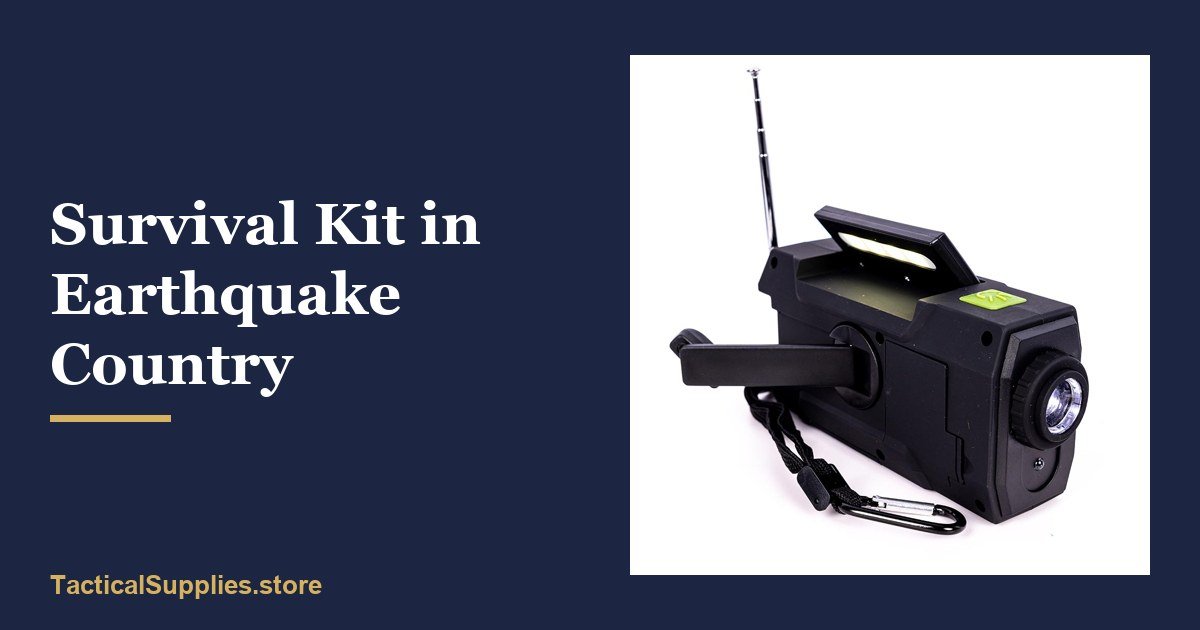
This guide covers where each part of your survival kit in earthquake zones should live, what goes in it, and how to use it in the first 72 hours. If you want the bigger picture first, start with our city-by-city earthquake preparedness guide for California.
Why a survival kit in earthquake country is different
Most disasters come with a forecast. Hurricanes give you days, winter storms give you hours. An earthquake gives you seconds, if you get an alert at all. That changes what a good kit looks like in three ways:
- Location matters more than size. A big kit you can’t reach because a bookcase fell across the hallway does nothing for you.
- The first hazards are broken glass, dust and darkness. Quakes often strike at night, and the first thing you need is shoes and a light, not food.
- Utilities can fail for days. Water mains, gas lines and power lines can all be damaged at once, so you plan for no tap water, no stove and no power at the same time.
The risk is real for millions of families. According to the U.S. Geological Survey, there is a 60% chance of a magnitude 6.7 or larger earthquake in the Los Angeles area and a 72% chance in the San Francisco Bay Area over the next 30 years. Oregon and Washington face serious risk too, which is why the ShakeAlert-powered MyShake app now covers California, Oregon and Washington.
The 5 layers of a survival kit in earthquake country
The Earthquake Country Alliance, the California-based group behind the Great ShakeOut drills, recommends separate kits for the bedroom, your go-bag or car, and the household. We add your phone and your workplace, since that is where many people will actually be.
1. On you: your phone
Install the free MyShake app and turn on emergency alerts. ShakeAlert can sometimes give a few seconds of warning before strong shaking reaches you, which is enough time to Drop, Cover, and Hold On. Keep a small charged power bank in your bag so your phone survives the first day.
2. Under the bed: the 30-second kit
This is the piece most people skip, and it matters most at night. The Earthquake Country Alliance suggests keeping these in a bag tied to the bed frame so it doesn’t slide away:
- Sturdy shoes and socks (broken glass is the classic earthquake injury)
- Glasses or contacts
- Flashlight or headlamp
- Dust mask
- Whistle
- Work gloves
3. In the car: the 3-day go-bag
If your home is damaged or you’re stuck away from it, your car kit becomes your survival kit in earthquake conditions. Ready.gov recommends keeping emergency supplies in the car in case you are stranded. Pack medications and a prescription list, a first aid kit, bottled water, high-calorie snacks, a flashlight with spare batteries, a portable radio, emergency cash, copies of ID and out-of-area contact numbers.
For food, the My Patriot Supply 1-Week Food Supply Ammo Can fits this job well. It holds 14,860 calories (2,000+ per day for one person for a week, or two people for 72 hours) in a durable 14″ x 7″ x 8 1/2″ ammo can, with a listed shelf life of up to 25 years when stored properly. Be honest with yourself about one limit: the meals need water and heat, about 2.96 gallons of water for the full supply, so keep a few snacks that need nothing at all. Also note that car interiors get hot, and heat shortens the life of any stored food, so check the kit each year.
4. At work: the 24-hour kit
Ready.gov advises being prepared to shelter at work for at least 24 hours, with a grab-and-go case holding food, water, medicines and comfortable walking shoes. If bridges or freeways are closed, the walk home could be long.
5. At home: the 2-week household supply
The Earthquake Country Alliance recommends at least 3 days and ideally 2 weeks of water and food at home, stored in a large, watertight container that is easy to move. Include wrenches for gas and water shutoff, extra flashlights, a radio, blankets, warm clothing, heavy-duty plastic bags, pet supplies and copies of vital documents.
Two weeks of food for a family adds up fast. The 4-Week Emergency Food Supply covers one person for four weeks, two people for two weeks, or a family of four for one week, packed in two stackable, water-resistant buckets. For more on amounts and storage spots, see our California earthquake emergency food guide.
Water: the part of a survival kit in earthquake zones that runs out first
Ready.gov and the Earthquake Country Alliance both recommend at least one gallon of water per person per day. A family of four needs 12 gallons for three days and 56 gallons for two weeks. That’s a lot of jugs, so most families store what they can and add a way to make more.
A gravity filter works without power or plumbing. The Alexapure Pro Water Filtration System uses 2.5-gallon chambers, is made in the USA, and the maker says it was tested against 220+ contaminants. Follow your local water utility’s advisories after a quake, since a filter is a backup, not a reason to ignore a boil-water notice. Our emergency water kit guide covers storage containers and rotation.
Power: keep the phone and radio alive
After a big quake, power can be out for days while crews check lines. You don’t need to run the whole house. You need lights, a radio for official updates, phones, and for some families a CPAP or other medical device.
The Grid Doctor 300 Solar Generator is sized for exactly that: a 320Wh LiFePO4 battery, 300W continuous output, 9 ports and a 100W solar panel included. It weighs about 8.6 pounds, so you can carry it out of a damaged house. It is not built for a full-size refrigerator or space heater. For more on keeping essentials running, see our power outage emergency kit.
How to use your survival kit in earthquake aftermath: the first 72 hours
- During the shaking: Drop, Cover, and Hold On. Ready.gov says to stay inside and avoid doorways. In bed, turn face down and protect your head and neck with a pillow. In a car, pull over, stop and set the parking brake.
- Right after: Put on your shoes, grab your light and check for injuries. Expect aftershocks and be ready to Drop, Cover, and Hold On again.
- Check for hazards: Watch for gas and water leaks, building damage and downed power lines. If the building is damaged, leave quickly and don’t go back in.
- Near the coast: If you live in a tsunami zone, move inland or to higher ground as soon as the shaking stops.
- If you’re trapped: Text, or tap on a pipe or wall. Use your whistle instead of shouting so you save your energy and avoid breathing dust.
- Stay informed: Follow local news and alerts on a battery-powered radio or your phone.
Frequently asked questions
What is the most important item in a survival kit in earthquake country?
Sturdy shoes by the bed and a flashlight. Most people will be fine on food for the first day, but walking through broken glass in the dark causes real injuries. After that, water is the priority.
Should I stand in a doorway during an earthquake?
No. Ready.gov specifically says to avoid doorways. Drop to your hands and knees, cover your head and neck, and hold on until the shaking stops.
How many days of supplies do I need for an earthquake?
Plan on at least 3 days in your go-bag and car kit. The Earthquake Country Alliance recommends 2 weeks of water and food at home, since a major quake can disrupt water and roads for a long time.
Does homeowner’s insurance cover earthquake damage?
According to Ready.gov, a standard homeowner’s insurance policy does not cover earthquake damage. Earthquake coverage is usually a separate policy, so check with your insurer.
The bottom line
A survival kit in earthquake country is less about buying more gear and more about putting it in the right places: shoes and a light by the bed, a 3-day bag in the car, a day of supplies at work, and two weeks of water and food at home. Start with the under-bed bag tonight, since it costs almost nothing, then build out the rest one layer at a time.
Sources: USGS: Earthquake probabilities for Los Angeles and the San Francisco Bay Area, Ready.gov (FEMA): Earthquakes, Ready.gov: Build a Kit, Earthquake Country Alliance: Organize Disaster Supplies, MyShake (UC Berkeley and Cal OES). Product details are from My Patriot Supply product pages as of October 27, 2026.