Disclosure: this post contains affiliate links. If you buy through them, we may earn a commission at no extra cost to you.
How long will MRE last on your shelf? The short answer from the U.S. military’s own standard is about three years at 80°F, and only about six months at 100°F. Temperature matters more than anything else, so the same case of MREs can stay good for years in a cool closet or fade fast in a hot garage.
Quick pick: How Long Will MRE Last? Shelf Life by Temperature, Date Codes and Signs of Spoilage
Food: 1-Week Food Supply Ammo Can
2,000+ calories a day for one person for a week, shelf life of up to 25 years.
Check today’s price
Heat and cooking: VESTA Indoor Heater & Stove
No electricity needed and doubles as a stove. Use it with ventilation.
Check today’s price
Food: 4-Week Emergency Food Supply
Feeds one person for four weeks or a family of four for one week.
Check today’s price
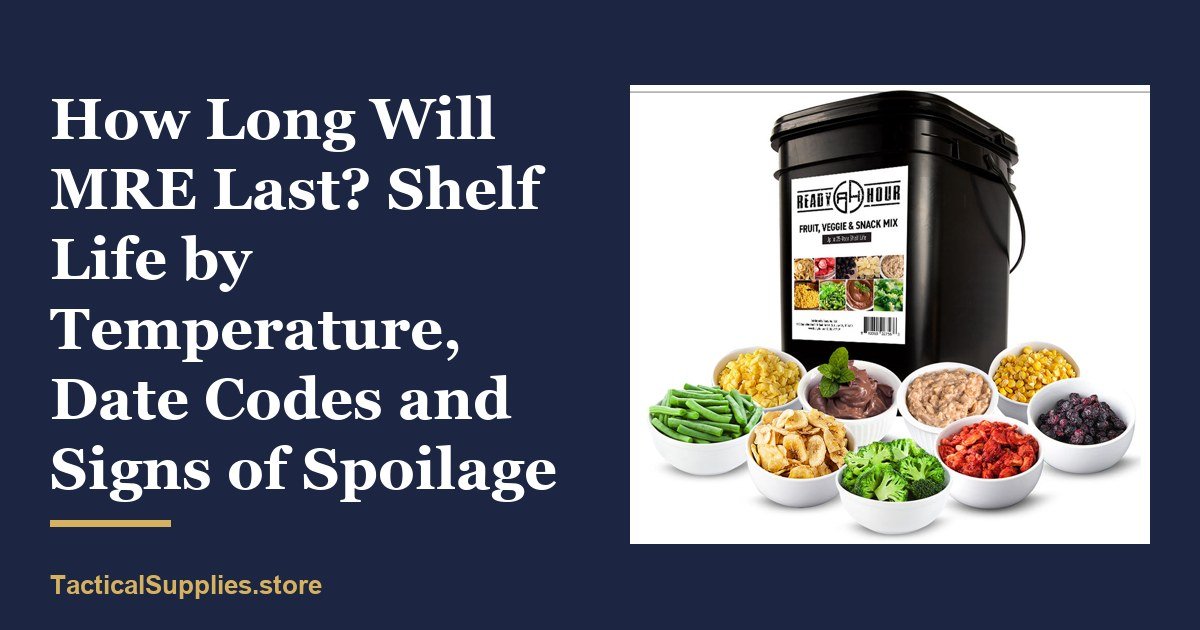
This guide explains where those numbers come from, how to read the date code, how to tell if an MRE has gone bad, and when a longer-lasting food option makes more sense for your family.
How long will MRE last? The military standard
MREs (Meals, Ready-to-Eat) were built for soldiers, so their shelf life is set by military testing, not marketing. According to the U.S. Army, new MRE items must remain fit to eat after six months at 100 degrees Fahrenheit and three years at 80 degrees Fahrenheit before they are even evaluated by troops.
Defense Logistics Agency contract specifications use the same benchmark: suppliers must certify a 36-month shelf life at 80°F, and the government can check it by storing samples for 6 months at 100°F or 36 months at 80°F. After storage, the food goes to a sensory panel that scores appearance, odor, flavor and texture, and it must score at least 5 on a 9-point scale to pass.
Two things follow from that:
- The rating is about quality, not a hard safety cliff. The test asks whether the food is still acceptable to eat. Quality fades gradually; it doesn’t flip off on a specific date.
- Heat is the main enemy. Going from 80°F to 100°F cuts the tested shelf life from three years to six months. The Defense Logistics Agency notes that cold storage before distribution can extend shelf life.
How long will MRE last in a car, garage or closet?
Use the military numbers as your guide and think about the hottest place your MREs will sit, not the average.
- Indoor closet or pantry, around room temperature: this is close to the conditions where the three-year standard applies. Cooler and steadier is better.
- Garage or attic: in many parts of the country these spaces pass 100°F in summer. Six months at that heat is the tested limit, so a garage is a poor long-term spot.
- Car trunk: parked cars get hotter than the air outside. MREs in a vehicle kit are fine for convenience, but plan to rotate them often and treat them as short-term food.
If you’re asking how long will MRE last in your own home, the honest answer is: check the date code, check your storage temperature, and rotate.
How to read an MRE date code
Military-spec MREs don’t usually show a simple “best by” date. According to a Defense Logistics Agency packaging specification, each pouch carries a date-of-pack code. In the four-digit version, the first digit is the last digit of the year and the next three digits are the day of the year (the Julian date).
- Example: a code of 5123 means it was packed on day 123 of 2025, which is May 3, 2025.
- Then do the math: add about three years for room-temperature storage, and much less if it has lived somewhere hot.
Civilian MRE brands set their own dates and storage guidance, so read the case label and the maker’s instructions. Also keep in mind you usually don’t know how a surplus case was stored before you bought it, which is a real limit on how long it will last for you.
Signs an MRE has gone bad
Ready.gov’s food safety guidance says not to eat food from cans that are swollen, dented or corroded, even if the product looks safe, and not to eat any food that looks or smells abnormal. Apply the same caution to MRE pouches:
- A puffy, swollen or leaking pouch
- Torn or punctured packaging
- An off smell, odd color or strange texture when opened
- Crackers or snacks that are badly stale or rancid
When in doubt, throw it out. An emergency is the worst possible time to get food poisoning.
How long will MRE last compared with long-term freeze-dried food?
MREs are great for what they were built for: eating on the move with no water and no cooking. That makes them handy for a go-bag or a car. For a home food supply that will sit for years, their roughly three-year rating is short, which means more frequent replacement.
That’s where purpose-built long-term emergency food fits. My Patriot Supply lists a shelf life of up to 25 years when stored properly in a cool, dry place for its core food kits. The tradeoff is preparation: these meals need water and heat, while an MRE is ready as is. For a deeper comparison, see our freeze-dried food shelf life guide and our roundup of the best MRE meals.
Options by how long you want to be covered
- Grab-and-go: the 1-Week Food Supply Ammo Can holds 14,860 calories (2,000+ per day for one person for a week) and needs 2.96 gallons of water to prepare everything.
- Household backup: the 4-Week Emergency Food Supply covers one person for four weeks or a family of four for one week, with 250 servings in two stackable buckets.
- Deeper reserve: the 3-Month Emergency Food Supply covers one person for three months or a family of four for three weeks, and needs 36.12 gallons of water to prepare the full supply.
- Extra calories: the MEGA 3-Month Supply averages 2,400+ calories per day with 33 food and drink varieties, for people with higher calorie needs.
Since these meals need heat, plan a cooking method that works without power. The VESTA heater and stove runs on InstaFire canned fuel and is designed for indoor use with adequate ventilation. More options are in our guide to 25-year shelf life food.
Why shelf life is on more people’s minds
Long-term food storage got fresh attention this fall. According to Pentagon documents reviewed by Fox News, major U.S. bases are being asked to plan to sustain essential operations for at least 90 days on their own under the FORTRESS America initiative; the Pentagon hasn’t released the memo, and Snopes rates the reporting “mostly true.” Around the same time, the U.K. urged families to stockpile food and water. Neither is a reason to panic, but both are a good nudge to check what’s in your pantry and when it expires.
5 simple rules to make MREs last longer
- Store them cool and dry, ideally indoors and well below 80°F.
- Avoid temperature swings, so skip attics, sheds and vehicles for long-term storage.
- Write the pack date on the case in plain numbers so you don’t have to decode it later.
- Rotate: eat the oldest ones on camping trips and replace them.
- Inspect before eating: no swollen, torn or bad-smelling pouches.
Frequently asked questions
How long will MRE last at room temperature?
The military standard is three years at 80°F. Cooler storage generally helps, and the Defense Logistics Agency notes cold storage can extend shelf life.
Can you eat an MRE past its date?
The military rating is a quality benchmark, so an older MRE stored cool may still be acceptable. Only eat it if the pouch is intact and the food looks and smells normal. If in doubt, throw it out.
How long will MRE last in a hot car?
Not long. The military standard drops to six months at 100°F, and a parked car can get hotter than that. Rotate any MREs you keep in a vehicle often.
Do MREs last longer than freeze-dried food?
No. MREs are rated for about three years at 80°F, while My Patriot Supply lists up to 25 years for its long-term food kits when stored properly. MREs win on convenience, since they need no water.
The bottom line
How long will MRE last? Plan on about three years in a cool home and far less in heat. MREs are excellent for go-bags and cars, but for a home supply that sits for years, long-shelf-life emergency food means less replacing. For more ways to build your food plan, see our power outage emergency kit.
Sources: U.S. Army: What to expect in the next iteration of MREs, Defense Logistics Agency: Meal, Ready-to-Eat, DLA packaging specification PCR-C-093, Ready.gov: Food, Fox News, Fortune, Snopes. Product details are from My Patriot Supply product pages as of October 27, 2026.