Disclosure: this post contains affiliate links. If you buy through them, we may earn a commission at no extra cost to you.
Earthquake preparedness California families can actually use comes down to three risks, not one. The ground can shake without warning, wildfires can force an evacuation in minutes, and utilities can shut off your power on purpose to prevent fires. This guide covers all three, then shows you exactly where to sign up for official emergency alerts in 25 of the state’s largest cities.
Quick pick: Earthquake Preparedness California
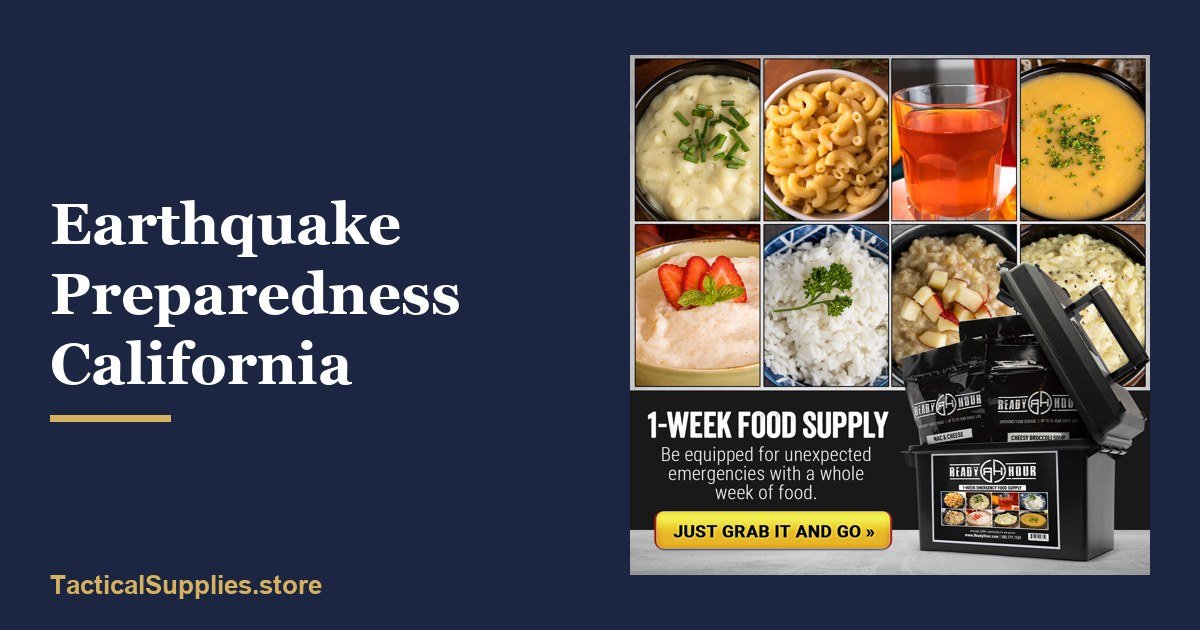
Food: 1-Week Food Supply Ammo Can
2,000+ calories a day for one person for a week, shelf life of up to 25 years.
Check today’s price
Water: Alexapure Pro Water Filtration System
Gravity-powered, so it makes drinking water with no electricity or plumbing.
Check today’s price
Power: Grid Doctor 300 Solar Generator
320Wh battery with a 100W solar panel, under 9 pounds. For phones, lights and a CPAP.
Check today’s price
The goal: one kit, one plan and the right alerts on your phone.
Why earthquake preparedness California style covers more than quakes
California families live with several hazards at once, and they overlap. A wildfire can trigger a Public Safety Power Shutoff, and a strong earthquake can knock out power, water and phone service at the same time. The good news is that one earthquake preparedness California plan covers most of it: food that needs no fridge, stored water, light, a way to charge phones and a grab-and-go bag.
Risk 1: Earthquakes
The U.S. Geological Survey estimates, using its latest statewide forecast model, that the Los Angeles area has a 60% chance and the San Francisco Bay Area a 72% chance of a magnitude 6.7 or larger earthquake within the next 30 years. Those are not predictions of a date, but they are why earthquake preparedness California households do now matters.
During the shaking: Drop, Cover, and Hold On
The Earthquake Country Alliance teaches one response for most situations: drop to the ground before the shaking knocks you down, take cover under a sturdy table or desk (or next to an interior wall, away from windows, protecting your head and neck), and hold on until the shaking stops. If you are in bed, stay there and cover your head with a pillow.
- Do not run outside during shaking. Exterior walls and windows are often the first parts of a building to fail.
- Do not stand in a doorway. In modern homes, doorways are no stronger than the rest of the house.
Before the next quake
Ready.gov recommends securing heavy items like bookcases, refrigerators, water heaters and televisions, and keeping heavy or breakable objects on low shelves. After a quake, watch for leaking gas and water lines and downed power lines, be ready to Drop, Cover, and Hold On again during aftershocks, and use text messages instead of calls, since texts may get through more reliably and save battery.
Get earthquake warnings on your phone
The MyShake app, from UC Berkeley and Cal OES, delivers ShakeAlert-powered earthquake alerts across California, Oregon and Washington. It is on the Apple App Store and Google Play. Installing it is one of the easiest earthquake preparedness California steps you can take today.
Risk 2: Wildfires and evacuation
Any earthquake preparedness California plan should include wildfire evacuation. CAL FIRE’s Ready for Wildfire program publishes a Go! Evacuation Guide, and its key message is not to wait: fire officials say that if you are advised to evacuate, leave right away, and that you should not wait for an evacuation order if you feel at risk. In large fires there is often no time for door-to-door warnings.
Wildfire evacuation checklist (from CAL FIRE)
CAL FIRE’s Go Bag checklist recommends packing:
- A 3-day supply of non-perishable food and 3 gallons of water per person
- A map with at least 2 evacuation routes
- Prescriptions and medications
- A change of clothes and extra glasses or contact lenses
- Extra car keys, credit cards and cash
- A first aid kit and sanitation supplies
- A flashlight and battery-powered radio with extra batteries
- Copies of important documents, such as birth certificates and passports
- Pet food and water
CAL FIRE also suggests keeping sturdy shoes and a flashlight by your bed for night evacuations, keeping at least half a tank of gas in your car, and parking facing out with your emergency kit already loaded when fire is near. For a deeper packing list, see our complete bug out bag list.
Risk 3: Public Safety Power Shutoffs (PSPS)
According to the California Public Utilities Commission, a Public Safety Power Shutoff is when a utility temporarily turns off power to specific areas to reduce the risk of fires caused by electric infrastructure. It is meant as a last resort during strong winds and dry conditions. Utilities that can call a PSPS include PG&E, Southern California Edison, SDG&E, Liberty Utilities, Bear Valley Electric Service and PacifiCorp.
How PSPS notifications work
- PG&E says it sends alerts by email, phone and/or text as early as possible, but in some cases the first alert may come the same day power is shut off. Account holders are enrolled automatically, and anyone can sign up for Address Alerts for places like a parent’s home or a child’s school.
- Southern California Edison says it begins notifications up to three days ahead, with an expected-shutoff notice one to four hours before, when possible. Non-customers can sign up for Address Level Alerts.
- SDG&E says it aims to notify customers about 48 hours before a possible shutoff, then about 24 hours before, then a few hours before. Its Alerts by SDG&E app can track up to 5 addresses.
Whoever your utility is, keep your contact information current in your online account. If someone in your home depends on powered medical equipment, PG&E advises having a backup power source or another plan, and you can ask your utility about its Medical Baseline program. Build shutoffs into your earthquake preparedness California plan the same way you would any outage. Our power outage emergency kit guide covers lights, food safety and phone power in detail.
Your California emergency kit: what actually helps
One well-built California emergency kit handles all three risks. Here is what earthquake preparedness California households should prioritize, plus a few products that genuinely fit.
Food that needs no fridge
Earthquakes can close stores and roads, and a PSPS leaves your refrigerator dark. A compact option is the My Patriot Supply 1-Week Food Supply Ammo Can: 14,860 calories (2,000+ per day for one person for a week, or two people for 72 hours), a shelf life of up to 25 years when stored properly, and about 2.96 gallons of water to prepare all of it. The ammo can is easy to toss in the car during an evacuation.
For a family, the 4-Week Emergency Food Supply covers one person for four weeks, two people for two weeks or a family of four for one week, and needs about 9.14 gallons of water to prepare. For more on food planning, see our California earthquake emergency food guide.
Water, and a way to filter more
Ready.gov recommends at least one gallon of water per person per day for several days, and notes that needs can double in very hot weather. A major quake can damage water lines, so a backup filter helps. The Alexapure Pro Water Filtration System is gravity-powered, so it runs without electricity or plumbing, uses 2.5-gallon chambers, and its maker says it was tested against 220+ contaminants. It is a countertop system for home, not something to carry during a wildfire evacuation.
Power for phones, lights and medical devices
Phones are how you get evacuation orders and PSPS updates, so power matters. The Grid Doctor 300 Solar Generator has a 320Wh LiFePO4 battery, 300W pure sine wave output and a 100W solar panel, and the maker lists CPAP machines, phones, laptops and lights as typical uses. It is not built for a full-size fridge, microwave or space heater.
If PSPS events in your area run several days and you want to keep a refrigerator going, the Grid Doctor 3300 Solar Generator is the size class built for that: 3300W continuous output, a 2,048Wh battery expandable to 16,384Wh, and solar charging. At 57.2 pounds, it is a stay-at-home system, not something to grab on the way out the door.
Cooking when the power is out
During a PSPS, the VESTA Self-Powered Indoor Space Heater and Stove heats water and meals with no electricity using canned fuel. The maker says it is meant for spaces up to about 200 square feet and should be used with proper ventilation. Because it uses a flame, do not use it after an earthquake until you are sure there is no gas leak. Keep a battery-powered carbon monoxide detector with any fuel-burning device.
The rest of the kit
- Flashlights or headlamps, a battery or hand-crank radio and spare batteries
- Power banks and charging cables
- First aid kit and at least a week of prescriptions
- Copies of IDs and insurance papers, plus cash in small bills
- Sturdy shoes and work gloves for broken glass after a quake
Our 72-hour emergency kit checklist is a good printable starting point.
Your city or county: official emergency alert signups
County alert systems send targeted warnings by text, email and phone, and many require you to opt in. Find your city below and sign up for every county where you live or work. This is the single highest-value earthquake preparedness California step on this page.
Los Angeles County: Los Angeles, Long Beach, Glendale, Santa Clarita
Residents of Los Angeles, Long Beach, Glendale and Santa Clarita can register for Alert LA County, the county’s opt-in system for text, email and phone alerts.
San Diego County: San Diego, Chula Vista, Oceanside
San Diego, Chula Vista and Oceanside residents can sign up through AlertSanDiego, the county’s regional emergency alert site.
Santa Clara County: San Jose
San Jose residents can sign up for AlertSCC through the county Office of Emergency Management.
San Francisco
San Francisco residents can sign up for AlertSF on SF.gov.
Alameda County: Oakland, Fremont
Oakland and Fremont residents can register for AC Alert through the Alameda County Office of Emergency Services.
Sacramento County: Sacramento
Sacramento residents can sign up for Sacramento Alert, run by the county with Yolo and Placer counties.
Fresno County: Fresno
Fresno residents can use the “Register to receive Emergency Alerts” link on the Fresno County Emergency page.
Kern County: Bakersfield
Bakersfield residents can sign up for ReadyKern, Kern County’s emergency notification system.
Orange County: Anaheim, Santa Ana, Irvine, Huntington Beach
Anaheim, Santa Ana, Irvine and Huntington Beach residents can register for AlertOC, the county’s mass notification system, through ReadyOC.
Riverside County: Riverside, Moreno Valley
Riverside and Moreno Valley residents can sign up for Alert RivCo from the county Emergency Management Department.
San Bernardino County: San Bernardino, Fontana
San Bernardino and Fontana residents can register for TENS, the Telephone Emergency Notification System, on the county OES Stay Informed page.
San Joaquin County: Stockton
Stockton residents can sign up for emergency notifications through SJReady, the county’s preparedness site.
Stanislaus County: Modesto
Modesto residents can register for StanAware, the county’s emergency communications system.
Ventura County: Oxnard
Oxnard residents can sign up for VC Alert, Ventura County’s emergency notification system.
Sign-up pages change from time to time. If a link moves, search your county’s Office of Emergency Services website.
Frequently asked questions
What is the first step in earthquake preparedness California residents should take?
Sign up for your county’s emergency alerts and install MyShake. Then build a basic 3-day kit.
Do I need different kits for earthquakes and wildfires?
Mostly no. Keep a portable go bag for evacuations and a larger home supply for sheltering in place after a quake or during a PSPS. The core items (food, water, light, medications and documents) are the same.
Does MyShake work everywhere in California?
Yes. MyShake delivers ShakeAlert-powered alerts across California, Oregon and Washington.
The bottom line
Good earthquake preparedness California families can stick with is not complicated. Sign up for your county’s alerts, install MyShake, learn Drop, Cover, and Hold On, pack a wildfire go bag and keep enough food, water and power at home to ride out a quake or a multi-day shutoff. Start with three days, then build up from there.
Sources: USGS: Earthquake probabilities, Earthquake Country Alliance: Drop, Cover, and Hold On, Ready.gov: Earthquakes, Ready.gov: Water, MyShake, CAL FIRE: Go! Evacuation Guide, CAL FIRE: Create Your Go Bag, CPUC: Public Safety Power Shutoffs, PG&E: PSPS, SCE: PSPS, SDG&E: PSPS, plus the county alert pages linked above. Product details are from My Patriot Supply product pages as of October 27, 2026.