Disclosure: this post contains affiliate links. If you buy through them, we may earn a commission at no extra cost to you.
Search for “food shortage 2026” and you’ll find videos promising empty shelves by Christmas. The government data tells a calmer story. Food prices are still rising, a few items have jumped hard, and plenty of families feel the squeeze at the checkout, but we found no credible forecast of a nationwide food shortage in 2026.
Quick pick: Food Shortage 2026
Food: 1-Week Food Supply Ammo Can
2,000+ calories a day for one person for a week, shelf life of up to 25 years.
Check today’s price
Water: Alexapure Pro Water Filtration System
Gravity-powered, so it makes drinking water with no electricity or plumbing.
Check today’s price
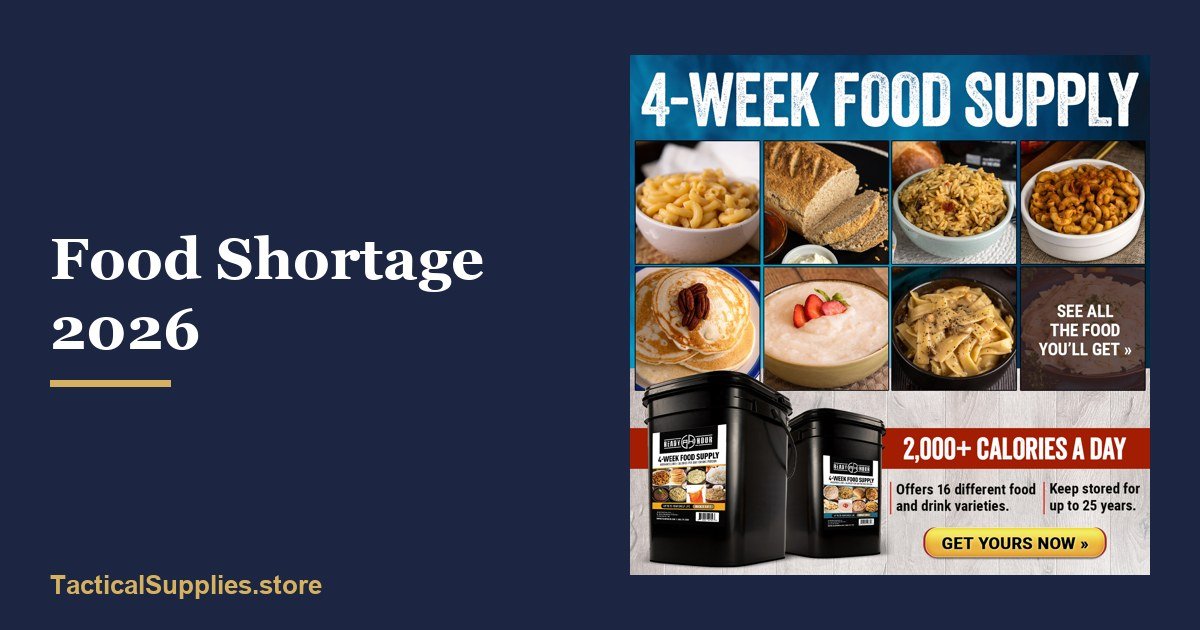
Food: 4-Week Emergency Food Supply
Feeds one person for four weeks or a family of four for one week.
Check today’s price
Here’s what the numbers actually say, where the hype comes from, and a simple pantry plan that makes sense no matter which way things go.
Is there a food shortage in 2026? What the data shows
The most reliable source on U.S. food prices is the USDA Economic Research Service (ERS), which updates its Food Price Outlook every month. The October 23, 2026 update says food prices in September 2026 were 2.5% higher than a year earlier. Grocery prices were up 1.8%, and restaurant prices were up 3.5%.
For the full year, ERS forecasts all food prices to rise 2.8% in 2026. That is slightly below the 20-year average of 3.0% per year. Grocery prices are forecast to rise 2.3%, also a little under their long-run average of 2.6%. The short version on food shortage 2026: steady inflation, not a supply collapse.
Where prices are rising fastest
- Beef and veal: forecast up 8.7% in 2026. ERS points to lower beef production, which it expects to stay below year-ago levels through the end of 2026.
- Sugar and sweets: forecast up 6.5%.
- Fresh vegetables: forecast up 5.8%.
- Nonalcoholic beverages: forecast up 4.4%.
Where prices are falling
Eggs are the big swing. Retail egg prices rose 21.9% in 2025, mainly because of the outbreak of highly pathogenic avian influenza (bird flu) that began in 2022. As flocks recover, ERS forecasts egg prices to fall 29.3% in 2026. Dairy prices are forecast to dip slightly, and pork (up 1.0%) and poultry (up 1.2%) are rising far more slowly than beef.
Food shortage 2026: what’s real and what’s hype
So why is “food shortage 2026” a popular search at all? Part of it is real pressure on household budgets. Part of it is news that makes people nervous.
What’s real
- Higher prices on specific foods, with beef leading the way.
- Single-item shocks. The egg spike showed how one disease outbreak can hit one food hard and fast.
- Disasters that cut off access. Storms, floods and power outages can keep you from a store for days. That’s why FEMA’s Ready.gov tells every household to keep at least a several-day supply of non-perishable food.
- Uncertainty about next year. ERS forecasts all food prices to rise 1.7% in 2027, but its prediction interval runs from a 2.5% drop to a 6.2% increase. Nobody knows exactly.
What’s hype
Most of the scary food shortage 2026 content online falls into a few buckets:
- Claims of a coming nationwide food shortage. We found no USDA or other authoritative forecast saying one is on the way.
- “Buy now before it’s gone” urgency. Panic buying is what empties shelves in the first place, and it costs you more.
- One empty aisle presented as proof of a national crisis.
Why food shortage 2026 fears are in the news this fall
On September 30, Defense Secretary Pete Hegseth announced FORTRESS America, an initiative to make major U.S. military bases able to run on their own power. According to Pentagon documents reviewed by Fox News, major bases in the continental U.S. are being asked to plan to sustain essential operations for at least 90 days on their own. The Pentagon hasn’t released the memo publicly, and Snopes rates the reporting “mostly true.” Around the same time, Britain urged families to stockpile food and water (Fortune, Oct. 26).
Neither of those is a prediction of a food shortage. They are planning steps. The takeaway for a family is the same one emergency managers have repeated for years: keep enough food at home to ride out a disruption without panic.
How to prepare for food shortage worries and higher prices
Whether or not the food shortage 2026 headlines pan out, the steps that protect you from a shortage are the same ones that protect you from rising prices, a job loss or a week-long power outage. Here’s a sensible plan.
Step 1: Build a pantry you actually eat from
Your best defense against food shortage 2026 worries is a pantry you use every week. Buy a little extra of what your family already eats each time you shop, especially when it’s on sale. Ready-to-eat canned meats, fruits and vegetables, peanut butter, dry cereal and dried fruit are all on Ready.gov’s suggested list, and staples like rice, beans and pasta stretch the budget further. Use the oldest items first and put new ones at the back. For a full shopping list, see our guide to prepper pantry essentials and our emergency food supply list.
Where you store it matters. The USDA says to keep canned and shelf-stable food in a cool, dry place, ideally below 85°F, and never above the stove, under the sink or in a damp garage or basement.
Step 2: Set a target in weeks, not years
The FDA uses 2,000 calories a day as a general guide for nutrition advice, though real needs vary by age, size and activity. That gives you simple math:
- 2 weeks for one adult: about 28,000 calories.
- 2 weeks for a family of four: about 112,000 calories.
- 1 month for a family of four: about 240,000 calories.
Start with two weeks. Once that’s covered, work toward a month, then three months if your budget and space allow.
Step 3: Add a long-shelf-life layer
Grocery-store food needs rotating. A long-shelf-life layer is the part you can store and largely forget. The 1-Week Food Supply Ammo Can holds 14,860 calories (one person for a week, or two people for 72 hours) in a 14″ x 7″ x 8.5″ can. The 4-Week Emergency Food Supply provides 56,460 calories in two stackable buckets, enough for one person for four weeks, two people for two weeks or a family of four for one week. My Patriot Supply lists a shelf life of up to 25 years when stored properly for both.
If you want a bigger cushion, the 3-Month Emergency Food Supply provides 181,960 calories across 22 food and drink varieties in six buckets (102.53 pounds), covering one person for three months or a family of four for three weeks. If you’re new to this, our beginner’s guide to long-term food storage walks through the basics.
Step 4: Don’t forget water
Ready.gov advises storing at least one gallon of water per person per day for several days, for drinking and sanitation. Emergency meals need water too: the 4-Week kit needs about 9.14 gallons to prepare everything. A gravity filter like the Alexapure Pro Water Filtration System works without electricity, which helps if your tap water becomes unsafe during an outage.
Step 5: Shop the data, not the headlines
With beef forecast up 8.7% while pork and poultry rise about 1%, swapping some beef meals for chicken, pork or beans is an easy way to keep your grocery bill in check. Eggs are forecast to get much cheaper in 2026, so there’s no need to hoard them. If outages are your bigger worry, our power outage emergency kit guide covers food, water, heat and light together.
How much do you need? Use our free Emergency Food Calculator to see exactly how many calories and gallons of water your family needs, from 72 hours to a full year.
If a few weeks isn’t enough, see our 90 day food supply guide for the food and water math for a full three months.
Why are planners talking about 90 days? Our FORTRESS America explained guide separates what the Pentagon confirmed from what was only reported.
Frequently asked questions
Will there be a food shortage in 2026?
Based on USDA data, there’s no sign of a nationwide food shortage in 2026. Prices are rising at about their usual pace overall, with sharper increases for beef, fresh vegetables and sweets. Local shortages can still happen around disasters, which is why a home supply makes sense.
Are food prices going down in 2026?
Overall, no. ERS forecasts food prices to rise 2.8% in 2026. Some items are falling, though, most notably eggs, which are forecast to drop 29.3%.
How much food should I stockpile?
Start with at least a several-day supply, as Ready.gov recommends, then build to two weeks. Many families aim for one to three months. At about 2,000 calories per person per day, a family of four needs roughly 112,000 calories for two weeks.
Why is beef so expensive right now?
ERS links the 8.7% forecast increase to lower beef production, which it expects to stay below year-ago levels through the end of 2026.
The bottom line
The honest answer to “food shortage 2026” is that the data points to higher prices on some foods, not empty shelves nationwide. That’s still a good reason to prepare. A rotating pantry, a target of two weeks to three months, a long-shelf-life layer and a plan for water protect your family from price spikes, storms and outages alike, without the panic. That’s the smart way to handle food shortage 2026 headlines: prepare calmly, not fearfully.
Sources: USDA ERS Food Price Outlook (Oct. 23, 2026), Ready.gov: Food, Ready.gov: Water, USDA FSIS: Shelf-Stable Food Safety, FDA: How to Understand and Use the Nutrition Facts Label, Fox News, Fortune, Snopes. Product details are from My Patriot Supply product pages as of October 27, 2026.