Disclosure: this post contains affiliate links. If you buy through them, we may earn a commission at no extra cost to you.
Many people search for free government survival kits expecting to find a box of supplies the government will mail them before a disaster. That program doesn’t exist. Federal and state agencies do hand out relief supplies after a major disaster, and they offer a lot of free planning help, but knowing what free government survival kits really are (and what they aren’t) is the first step to a plan that works.
No free kit is coming in the mail. Start your own:
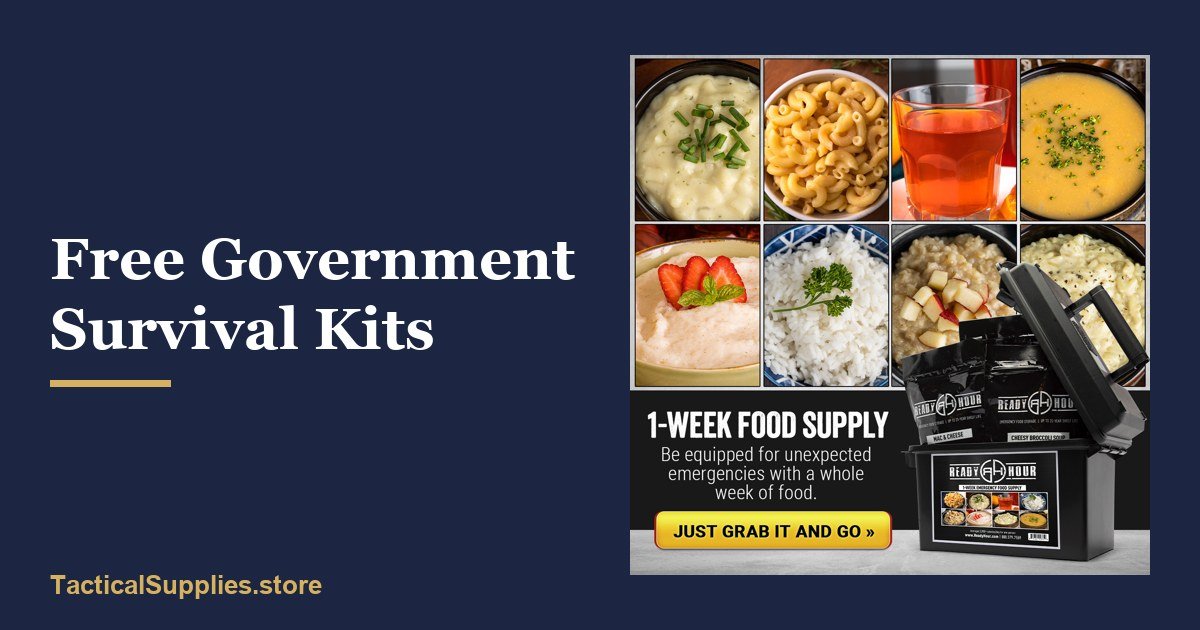
Food: 1-Week Food Supply Ammo Can
2,000+ calories a day for one person for a week, or two people for 72 hours.
Check today’s price
Water: Alexapure Pro Water Filtration System
Makes more drinking water without electricity or plumbing.
Check today’s price
Here’s what FEMA actually provides, where the gaps are, and what your family should keep at home.
Quick answer: are there free survival kits from FEMA?
No. FEMA does not mail free survival kits to households, and you cannot sign up for one in advance. Here is what free government help actually looks like:
- After a declared disaster: FEMA moves water, meals and tarps to staging areas and points of distribution, and local officials hand them out.
- Local kit giveaways: counties, aging agencies and charities sometimes give free kits to seniors and people with disabilities.
- Free CERT gear: some local CERT programs give graduates a backpack of basic response gear.
- Free planning help: Ready.gov checklists, CERT training and local emergency alerts.
For the first days of an emergency, the food and water have to come from you.
What Are Free Government Survival Kits?
When people talk about free government survival kits, they usually mean disaster relief supplies handed out after a declared emergency. In a large disaster, FEMA moves commodities such as meals, water and tarps into the affected area. After Hurricane Maria in 2017, for example, FEMA reported delivering millions of meals and liters of water, plus tens of thousands of tarps, to Puerto Rico and the U.S. Virgin Islands.
Those supplies don’t arrive at your door. According to FEMA, they were moved to staging areas, and local officials picked them up and distributed them to the public. Shelters run by voluntary groups such as the American Red Cross also provide meals and basic items.
The key point: there is no pre-packaged government kit you can request in advance. If a website offers you a “free FEMA survival kit” in exchange for your personal details or a shipping fee, be skeptical.
Where you can actually get free emergency kits
FEMA doesn’t mail kits, but free emergency kits and supplies do exist at the local level. They come from counties, state aging departments, charities and utilities, usually for seniors, people with disabilities or households with medical needs. Supplies are limited and programs change often, so think of these as bonuses, not a plan. Here is what we verified:
- County and state senior kit programs. In January 2026, the South Carolina Department of Aging, Colleton County Fire-Rescue and partners handed out about 200 free three-day emergency kits to seniors in Walterboro. In North Carolina, a Moore County coalition received a 2026 AARP Community Challenge grant to give 600 disaster kits to older adults. In New Jersey, the Monmouth County Sheriff’s STORM program gives seniors a free emergency supply kit after they complete a family disaster plan.
- Free smoke alarms from the Red Cross. Through its Sound the Alarm program, the American Red Cross installs free smoke alarms during home fire safety visits and says it has installed more than 2.5 million. Book a visit through your local Red Cross chapter.
- Utility programs for medical needs. Some utilities help customers who depend on powered medical equipment. California’s PG&E, for example, has offered free portable backup batteries to eligible income-qualified Medical Baseline customers in high fire-threat areas. Ask your own utility what it offers.
How to find a free kit program near you:
- Call your county or city emergency management office and ask whether it gives out kits or holds preparedness events.
- Older adults and caregivers can call the Eldercare Locator at 1-800-677-1116 to reach the local Area Agency on Aging, which often knows about senior kit giveaways.
- Dial 211, the free and confidential United Way referral line, to find local help before and after disasters.
- Watch for preparedness fairs from your fire department, library or senior center, especially in September (National Preparedness Month).
A real free kit program never asks for a credit card or a “shipping fee.” If one does, walk away.
Limitations of Government Emergency Supplies
Relief supplies are a lifeline, but free government survival kits in the form of disaster relief come with real limits:
- Timing. Large-scale federal help follows a disaster. It does not arrive the moment the power goes out or the road floods.
- Distance. Distribution points and shelters may be far from your home, and roads may be blocked.
- Quantity. Supplies are shared by everyone affected, so lines can be long.
- Basics only. Relief covers water, meals and shelter items. Prescription medications, infant formula, pet food and medical equipment are on you.
That’s why Ready.gov, FEMA’s own preparedness site, tells every household to keep at least several days of food and water on hand. The government’s message is consistent: plan to take care of yourself first.
What You Should Provide for Yourself
Rather than relying on free government survival kits, build your own supplies around the things relief can’t guarantee. Start with the two that matter most.
Water. Ready.gov recommends one gallon per person per day for several days. The CDC says to store at least 3 days’ worth and to try for a 2-week supply if you can. A family of four needs 12 gallons for 3 days, or 56 gallons for 2 weeks. A gravity filter such as the Alexapure Pro Water Filtration System lets you make more drinking water without electricity or plumbing. It has 2.5-gallon chambers, and the maker says it has been tested against 220+ contaminants.
Food. Keep food that stores at room temperature and needs little prep. A good first step is the 1-Week Food Supply Ammo Can, which provides 2,000+ calories a day for one person for a week (or two people for 72 hours). For a household, the 4-Week Emergency Food Supply feeds one person for four weeks, two people for two weeks, or a family of four for one week. Both list a shelf life of up to 25 years when stored properly. You can compare more options in the long-term emergency food storage range.
Government relief focuses on short-term survival after the fact. Your own supplies cover the gap before help arrives.
Building a Better Personal Kit
Your personal kit should go well beyond anything free government survival kits would include. Ready.gov’s basic list is a good backbone:
- Water and several days of non-perishable food, plus a manual can opener
- A battery-powered or hand-crank radio, ideally a NOAA Weather Radio with tone alert
- Flashlights and extra batteries
- A first aid kit
- A whistle, dust masks, plastic sheeting and duct tape
- Moist towelettes, garbage bags and plastic ties for sanitation
- A wrench or pliers to turn off utilities
- A cell phone with chargers and a backup battery
Then add what’s personal to your family: prescription medications, eyeglasses, infant supplies, pet food, cash, and copies of IDs and insurance policies in a waterproof container. For a numbered checklist, see what are 20 items in an emergency kit, and if outages are common where you live, our power outage emergency kit guide covers heat, light and power.
Government Resources Worth Using
Free government survival kits as pre-made packages don’t exist, but the government does offer valuable free help. These are worth your time:
- Ready.gov. FEMA’s site has free kit checklists, family plan templates and hazard-specific guides for floods, hurricanes, wildfires, power outages and more.
- CERT training. FEMA’s Community Emergency Response Team program trains volunteers in fire safety, basic search and rescue, team organization and disaster medical care. FEMA says there are more than 3,200 local programs in all 50 states. Ask your local emergency management office.
- NOAA Weather Radio and local alerts. Sign up for your county’s emergency alerts and keep a weather radio on hand.
- FEMA disaster assistance. After a declared disaster, FEMA’s Individuals and Households Program can help eligible survivors with uninsured or under-insured needs, such as temporary housing and home repairs. It is not a substitute for insurance. You apply through DisasterAssistance.gov.
One warning from FEMA itself: federal agencies will never charge you for disaster assistance or for help filling out an application. Anyone asking for a fee is not from FEMA.
Other governments are giving the same advice
The U.S. isn’t alone in asking families to prepare themselves. On October 22, the U.K. government launched a “Be Ready” campaign telling households to keep enough supplies to get through three days of disruption, including three liters of drinking water per person per day and food that needs no cooking or refrigeration, according to Fortune. The message on both sides of the Atlantic is the same: governments help after a disaster, but the first days are up to you.
How much do you need? Use our free Emergency Food Calculator to see exactly how many calories and gallons of water your family needs, from 72 hours to a full year.
Frequently asked questions
Does FEMA give out free survival kits?
Not in advance. There are no free government survival kits you can order ahead of time. After a major disaster, FEMA supports states and local officials in distributing water, meals and tarps, and shelters provide basic needs.
Is a “free FEMA kit” offer online legitimate?
Be very careful. FEMA says federal agencies never charge for disaster assistance or application help. If an offer asks for payment, banking details or a “shipping fee,” treat it as a likely scam.
Can seniors get free emergency kits?
Often, yes, through local programs rather than FEMA. Counties, state aging departments and charities hold kit giveaways for older adults and people with disabilities. Call the Eldercare Locator at 1-800-677-1116 or your county emergency management office to find one near you.
How much should I store if I can’t count on government help?
Start with at least 3 days of food and water, which matches Ready.gov and CDC guidance. Then build toward 2 weeks. Our 14-day emergency kit list shows how.
What free government preparedness resources are actually available?
Ready.gov checklists and planning guides, CERT training, local emergency alerts, and FEMA disaster assistance for eligible survivors after a declared disaster. A written family plan is free too; our emergency preparedness plan guide walks you through one.
Do CERT volunteers get free supplies?
Often, yes, but it is response gear, not a home survival kit. Many local CERT programs give graduates basic equipment. Fairfax County, Virginia, for example, says its CERT training is free of charge and that the program provides a CERT backpack with basic gear you keep after the training. What you get varies by program, so ask your local emergency management office.
Where do I pick up free FEMA supplies after a disaster?
FEMA does not hand supplies to individuals directly. After Hurricane Maria, it moved water, meals and tarps to regional staging areas and points of distribution, and local officials handed them out. Watch local emergency alerts and news for distribution sites, or dial 211 for help finding them.
The bottom line
Don’t count on free government survival kits to get your family through the first days of an emergency. FEMA’s relief supplies and assistance are real, but they come after the fact and cover only the basics. Use the free government guidance, build a kit of your own starting with water and food, and you’ll be ready well before help arrives.
Sources: FEMA: Commodities Flow to Disaster Survivors, FEMA: Individuals and Households Program, FEMA: Disaster Fraud, FEMA: CERT, Ready.gov: Build a Kit, CDC: Emergency Water Supply, Fortune. Live 5 News: free kits for seniors in Walterboro, Sandhills Sentinel: 600 Moore County kits, Monmouth County Sheriff: STORM program, American Red Cross: Sound the Alarm, CBS Sacramento: PG&E backup batteries, Eldercare Locator, 211.org, Fairfax County: CERT. Product details are from My Patriot Supply product pages as of October 27, 2026.