Disclosure: this post contains affiliate links. If you buy through them, we may earn a commission at no extra cost to you.
What are the 20 items in an emergency kit that you really cannot do without? Storms, floods, wildfires and power outages all look different, but the same basic supplies show up on every serious checklist, including FEMA’s Ready.gov list. This guide walks through all 20, grouped by job, with a short note on how much of each to keep.
Quick pick: What Are 20 Items in an Emergency Kit? The Complete Essential Supplies List
Water: Alexapure Pro Water Filtration System
Gravity-powered, so it makes drinking water with no electricity or plumbing.
Check today’s price
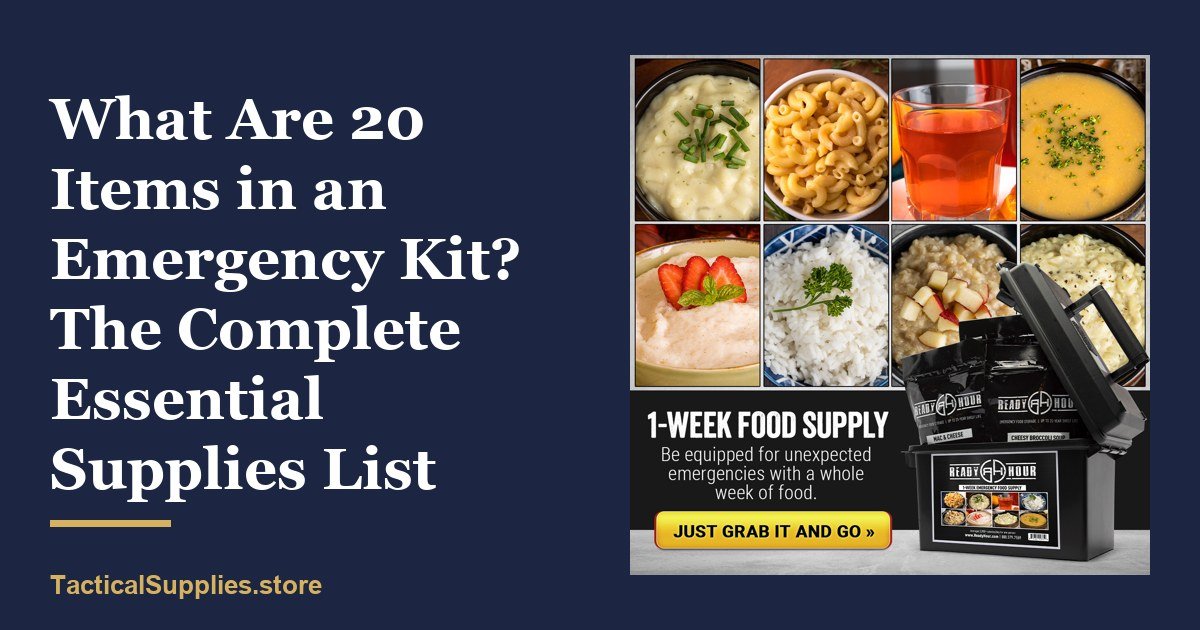
Food: 1-Week Food Supply Ammo Can
2,000+ calories a day for one person for a week, shelf life of up to 25 years.
Check today’s price
Power: Grid Doctor 300 Solar Generator
320Wh battery with a 100W solar panel, under 9 pounds. For phones, lights and a CPAP.
Check today’s price
Quick answer: the 20 items in an emergency kit are stored water, water purification tablets, a water filter, long-shelf-life food, energy bars, a manual can opener, a first aid kit, prescription medications, over-the-counter medicines, hygiene supplies, a flashlight with extra batteries, a NOAA weather radio, a phone charger and backup battery, blankets, plastic sheeting, waterproof matches, a multi-tool, duct tape, copies of important documents and cash.
You don’t have to buy everything at once. Most families already own about half of the 20 items in an emergency kit. The goal is to gather it in one place, top up what’s missing, and know it’s ready.
Water and Hydration (Items 1-3)
Water is the first of the 20 items in an emergency kit and tops every expert list, because you can’t go long without it and tap water can become unsafe after a disaster.
- Item 1: Stored drinking water. Ready.gov recommends one gallon per person per day for several days, for drinking and sanitation. The CDC says to store at least 3 days’ worth and to try for a 2-week supply if you can. Store more for pregnant women, people who are sick, pets, or if you live in a hot climate. The American Red Cross puts it in simple terms: a 3-day supply if you have to evacuate, and a 2-week supply for home.
- Item 2: Water purification tablets. A light, cheap backup for when stored water runs low.
- Item 3: A water filter. A filter lets you make more drinking water instead of relying only on what you stored.
For home use, a gravity filter is the easiest option because it needs no power or plumbing. The Alexapure Pro Water Filtration System is gravity-powered, has 2.5-gallon chambers, and its filter is made in the USA. The maker says it has been tested against 220+ contaminants. If you fill your own water containers, the CDC says to replace that water every 6 months.
Food Supplies (Items 4-6)
Food is the second pillar of the 20 items in an emergency kit. Pick food that stores at room temperature and needs little or no cooking.
- Item 4: Long-shelf-life emergency food. Enough for at least several days, which is the minimum Ready.gov suggests.
- Item 5: Energy bars and high-calorie snacks. Quick food you can eat on the move, with no water or heat.
- Item 6: A manual can opener. Ready.gov lists it on its basic kit, and it’s the item people forget most.
If you’d rather not assemble meals yourself, the 1-Week Food Supply Ammo Can is a simple grab-and-go option. It provides 14,860 calories (2,000+ per day for one person for a week, or two people for 72 hours), lists a shelf life of up to 25 years when stored properly, and needs about 2.96 gallons of water to prepare everything. You can also browse the full range of long-term emergency food supplies if you’re feeding a larger household.
Medical Essentials (Items 7-10)
Four of the 20 items in an emergency kit cover health, because minor injuries and everyday needs don’t stop during an emergency, and pharmacies may be closed.
- Item 7: A complete first aid kit. Bandages, gauze, antiseptic, tape, gloves and basic tools. A ready-made first aid and medical kit saves time. Our guide to 10 items in a first aid kit covers what belongs inside.
- Item 8: Prescription medications. The American Red Cross recommends at least a 7-day supply of medications and medical items. Ask your doctor or pharmacist how to keep extra on hand safely. Add spare eyeglasses or contact lens solution.
- Item 9: Over-the-counter medicines. Ready.gov suggests pain relievers, anti-diarrhea medication, antacids and laxatives.
- Item 10: Hygiene and sanitation supplies. Soap, hand sanitizer, disinfecting wipes, moist towelettes, garbage bags and plastic ties, plus feminine supplies.
Light and Communication (Items 11-13)
When the power is out, light and news become top priorities. These three cover both.
- Item 11: An LED flashlight with extra batteries. One per person is ideal. Headlamps keep your hands free.
- Item 12: A battery-powered or hand-crank radio. Ready.gov specifically recommends a NOAA Weather Radio with tone alert so you hear warnings even if cell service is down.
- Item 13: A way to charge your phone. Ready.gov lists a cell phone with chargers and a backup battery.
Power banks handle a few days of phone charging. If someone in your home uses a CPAP or you want to keep lights and a router running longer, the Grid Doctor 300 Solar Generator pairs a 320Wh LiFePO4 battery with 300W pure sine wave output and a 100W solar panel. Be clear on its limits: the maker says it is not designed for full-size refrigerators, microwaves or space heaters.
Shelter and Warmth (Items 14-16)
Staying warm and dry matters in every season, and even more if you have to shelter in place.
- Item 14: Emergency blankets or sleeping bags. Ready.gov suggests a sleeping bag or warm blanket for each person, plus a complete change of clothes and sturdy shoes.
- Item 15: Plastic sheeting and a tarp. Ready.gov lists plastic sheeting, scissors and duct tape for sheltering in place.
- Item 16: Matches in a waterproof container or a lighter. For lighting a stove or lantern safely.
A word on heat: never use a grill, camp stove or generator inside your home, basement or garage. The CDC warns these can cause carbon monoxide poisoning, and recommends battery-operated or battery-backup CO detectors. If you need indoor heat for a small room, choose something built for it, like the VESTA Self-Powered Indoor Space Heater & Stove, which needs no electricity, warms spaces up to about 200 square feet, and should be used with proper ventilation per the maker.
Tools and Documents (Items 17-20)
The last four of the 20 items in an emergency kit handle repairs, paperwork and money, the things that make recovery easier.
- Item 17: A multi-tool, plus a wrench or pliers. Ready.gov lists a wrench or pliers so you can turn off utilities if officials tell you to.
- Item 18: Duct tape and rope. For quick repairs, tying down tarps and securing gear.
- Item 19: Copies of important documents. IDs, insurance policies and bank records, in a waterproof, portable container or saved electronically.
- Item 20: Cash in small bills. Card readers and ATMs may not work without power.
Those are the 20 items in an emergency kit that form the foundation of disaster preparedness. Start with these essentials and expand based on your family and your local risks.
Quick checklist: 20 items in an emergency kit
Print this or save it to your phone, then check items off as you gather them.
- Stored water (1 gallon per person per day)
- Water purification tablets
- Water filter
- Long-shelf-life emergency food
- Energy bars and snacks
- Manual can opener
- First aid kit
- Prescription medications and glasses
- Over-the-counter medicines
- Hygiene and sanitation supplies
- Flashlight and extra batteries
- Battery or hand-crank NOAA weather radio
- Phone charger and backup battery
- Blankets or sleeping bags
- Plastic sheeting and tarp
- Waterproof matches or lighter
- Multi-tool, wrench or pliers
- Duct tape and rope
- Copies of important documents
- Cash in small bills
Complete Your Emergency Kit
Beyond the 20 items in an emergency kit listed above, add what your own household needs. Ready.gov’s basic list also includes a whistle to signal for help, a dust mask, and local maps, and its extended list adds a fire extinguisher, paper and pencil, and mess kits with paper plates and plastic utensils.
- Pets: pet food and extra water.
- Infants: formula, bottles, diapers, wipes and diaper rash cream.
- Older family members: mobility aids, hearing aid batteries, extra medication and comfort items.
- Kids: books, games and puzzles to keep spirits up.
If you might have to leave home in a hurry, pack a portable version too. Our bug out bag checklist covers 50 grab-and-go items and comes with a free printable PDF.
If outages are your biggest risk, our power outage emergency kit guide goes deeper on heat, light and power. If you want to plan beyond a few days, see the 14-day emergency kit list.
Store your kit in an easy-to-reach spot that everyone in the family knows about. Keep canned food in a cool, dry place and boxed food in tightly closed plastic or metal containers, as Ready.gov advises. Replace expired items, and rethink your needs every year as your family changes.
How much do you need? Use our free Emergency Food Calculator to see exactly how many calories and gallons of water your family needs, from 72 hours to a full year.
Related reading: Free Government Survival Kits.
Frequently asked questions
What is the most important item in an emergency kit?
Water. Ready.gov puts it first on its list at one gallon per person per day, for drinking and sanitation. Food, light and a first aid kit come right after.
How many days should my emergency kit cover?
Ready.gov recommends several days of food and water as a minimum. The CDC says at least 3 days of water and to aim for 2 weeks if possible. Start with 3 days and build from there.
Where should I keep my emergency kit?
Somewhere cool, dry and easy to reach, like a hall closet. Many families also keep a smaller kit in the car and at work. For a ready-to-go version, see our 72 hour kit checklist.
Do I need all 20 items in an emergency kit right away?
No. Start with water, food, a flashlight, a radio and a first aid kit, which cover most short emergencies. Add the rest a few items at a time, starting with whatever your family would miss most.
What does the Red Cross say to put in an emergency kit?
At a minimum, the American Red Cross lists water (one gallon per person per day), non-perishable food, a flashlight, a battery-powered or hand-crank radio, extra batteries, a first aid kit, a 7-day supply of medications, a multi-purpose tool, sanitation and hygiene items, copies of personal documents, a cell phone with chargers, family contact information, extra cash, an emergency blanket and local maps.
How often should I check my emergency kit?
Look through it at least once a year, and swap out expired food, medicine and batteries. Replace water you stored yourself every 6 months.
The bottom line
The 20 items in an emergency kit above cover the basics: water, food, first aid, light, warmth, tools and documents. Gather what you already own this week, fill in the gaps over time, and check the kit once a year. A little effort now makes any emergency far easier to get through.
Sources: Ready.gov (FEMA): Build a Kit, CDC: How to Create an Emergency Water Supply, CDC: Carbon Monoxide Poisoning Following Disasters, Ready.gov: Power Outages, American Red Cross: Survival Kit Supplies. Product details are from My Patriot Supply product pages as of October 27, 2026.