Disclosure: this post contains affiliate links. If you buy through them, we may earn a commission at no extra cost to you.
A survival gear kit is simply the set of supplies that lets your family get through a few days or more without power, running water or a trip to the store. You don’t need tactical everything. You need water, food, light, communication, first aid and a few tools, packed where you can find them fast.
Quick pick: Survival Gear Kit
Water: Alexapure Pro Water Filtration System
Gravity-powered, so it makes drinking water with no electricity or plumbing.
Check today’s price
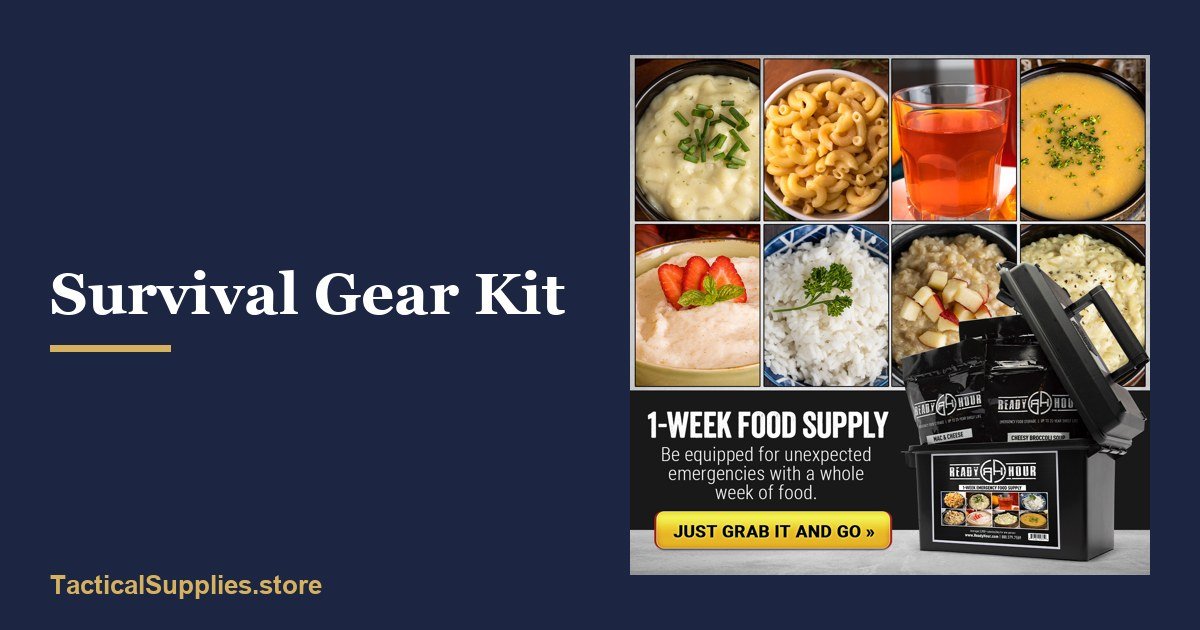
Food: 1-Week Food Supply Ammo Can
2,000+ calories a day for one person for a week, shelf life of up to 25 years.
Check today’s price
Power: Grid Doctor 300 Solar Generator
320Wh battery with a 100W solar panel, under 9 pounds. For phones, lights and a CPAP.
Check today’s price
This checklist is built on the Ready.gov basic disaster supplies list, organized into the 10 items that matter most, with notes on which pieces are worth buying and which you probably already own.
What a survival gear kit is (and where to keep one)
Ready.gov recommends keeping supplies in three places:
- Home: your main kit, in a designated, easy-to-reach spot every family member knows about.
- Work: a grab-and-go case with food, water, medicines and comfortable walking shoes, enough to shelter for at least 24 hours.
- Car: a supply kit in case you get stranded.
This guide focuses on the home survival gear kit, since that is where your family is most likely to ride out a storm or outage. If you need a portable version for evacuation, see our complete bug out bag list.
Why more families are building one now
On September 30, the Pentagon announced FORTRESS America, an initiative to make major U.S. bases able to run on their own power. According to Pentagon documents reviewed by Fox News, major continental U.S. bases are being asked to plan to sustain essential operations for at least 90 days independently. The Pentagon has not released the memo publicly, and Snopes rates the reporting “mostly true.” Britain has also urged families to stockpile food and water. A home kit is the civilian version of the same idea: a cushion that keeps you steady while things get back to normal.
The 10 essential survival gear kit items
1. Water, plus a way to make more
Ready.gov says to store one gallon of water per person per day for several days, for drinking and sanitation. The CDC recommends at least 3 days and a 2-week supply if possible. For a longer disruption, add a filter. The Alexapure Pro Water Filtration System is gravity-powered, needs no electricity or plumbing, and has 2.5-gallon chambers.
2. Food that needs no refrigeration
Ready.gov calls for at least a several-day supply of non-perishable food, plus a manual can opener. Canned goods and pantry staples work for short outages. For something you can store and forget, the 1-Week Food Supply Ammo Can provides 14,860 calories (one person for a week, or two people for 72 hours) with a listed shelf life of up to 25 years when stored properly. For a household, the 4-Week Emergency Food Supply covers one person for four weeks or a family of four for one week. Both are add-water-and-heat meals, so count the water too.
3. A radio
Ready.gov lists a battery-powered or hand-crank radio and a NOAA Weather Radio with tone alert. When cell networks are overloaded, a radio is how you hear evacuation orders and weather warnings.
4. Flashlights and extra batteries
Keep at least one flashlight per person and spare batteries that fit everything in the kit. A headlamp keeps your hands free for cooking or first aid in the dark.
5. First aid kit and medications
A stocked first aid kit, plus prescription and non-prescription medicines such as pain relievers, antacids and laxatives. Don’t forget prescription glasses and contact lens solution. Our guide to a first aid kit for home covers what to put in it.
6. Phone charging and backup power
Ready.gov lists a cell phone with chargers and a backup battery. Power banks cover a few days. If someone in your home uses a CPAP or you want solar recharging, the Grid Doctor 300 Solar Generator has a 320Wh LiFePO4 battery, 300W output and a 100W solar panel. It is built for phones, laptops, lights, radios and small medical devices, not a full-size fridge. For multi-day outages where refrigeration matters, the much larger Grid Doctor 3300 (3300W output, 2048Wh battery, expandable) is the one sized for that job.
7. Basic tools
A wrench or pliers (Ready.gov lists these so you can turn off utilities), a multi-tool, scissors, duct tape and work gloves.
8. Warmth and shelter
A sleeping bag or warm blanket for each person, a complete change of clothes and sturdy shoes. If you live where winters get cold, plan for safe indoor heat. The VESTA Self-Powered Indoor Space Heater & Stove runs on InstaFire canned heat (up to 6 hours per can), warms spaces up to 200 square feet, doubles as a cooking surface, and is designed for indoor use with adequate ventilation.
9. Safety and sanitation supplies
A whistle to signal for help, dust masks, plastic sheeting, moist towelettes, garbage bags and plastic ties. Add soap, hand sanitizer and disinfecting wipes.
10. Documents, cash and maps
Copies of IDs, insurance papers and family documents, saved electronically or in a waterproof container. Keep some cash, since card readers and ATMs need power, and a paper map of your area.
Extra survival gear kit items for families
- Infant formula, bottles, diapers, wipes and diaper rash cream
- Pet food and extra water
- Feminine supplies and personal hygiene items
- A fire extinguisher and waterproof matches
- Mess kits, paper plates, cups and utensils
- Paper, pencil, and books or games for kids
Heat and power safety: don’t skip this
The CDC warns that generators belong outdoors, at least 20 feet from windows, doors and vents, and never inside a home, basement or garage. Gas or charcoal grills and camp stoves should never be used inside either. The fumes are deadly. The CDC also recommends installing a battery-operated carbon monoxide detector, which keeps working when the power is out. Any heater you use indoors should be rated for indoor use, with the maker’s ventilation instructions followed exactly.
How to pack and maintain your survival gear kit
- Pack it right: Ready.gov suggests airtight plastic bags inside one or two easy-to-carry containers.
- Store food well: keep canned food cool and dry, and boxed food in tightly closed plastic or metal containers.
- Replace expired items such as batteries, medicines and food as needed.
- Review it once a year, and update it as your family’s needs change.
Printable survival gear kit checklist
- Water: 1 gallon per person per day, 3 days minimum, plus a filter
- Non-perishable food and a manual can opener
- Battery or hand-crank radio, NOAA Weather Radio
- Flashlights and extra batteries
- First aid kit, medications, glasses
- Phone chargers, backup battery or small solar generator
- Wrench or pliers, multi-tool, duct tape, gloves
- Sleeping bags or blankets, clothes, sturdy shoes, safe indoor heat
- Whistle, dust masks, plastic sheeting, sanitation supplies
- Documents, cash and local maps
- Battery-operated carbon monoxide detector
For the 72-hour version, see our 72 hour kit checklist, and for a grid-down focus, our power outage emergency kit guide.
Frequently asked questions
What are the most important items in a survival gear kit?
Water, food, a radio, a flashlight and a first aid kit. If you only get those five covered this week, you are already ahead of most households.
Is a survival gear kit the same as a bug out bag?
Not quite. A home kit can be heavier and hold more water and food because it stays put. A bug out bag is a lighter, portable kit for when you have to leave. Many families keep both.
Should I buy a prebuilt kit or build my own?
Building your own usually fits your family better, and you likely own half the items already. Buy the pieces that are hard to improvise: long-shelf-life food, a water filter and a reliable power source.
How often should I check my kit?
Ready.gov recommends reviewing your family’s needs once a year. Swap out expired food, medicines and batteries, and replace water you filled yourself every six months, per the CDC.
The bottom line
A good survival gear kit is boring on purpose: water, food, light, a radio, first aid, tools and warmth, packed where everyone can find them. Start with the basics you already own, fill the gaps one item at a time, and check the kit once a year. That is real preparedness for real families.
Sources: Ready.gov (FEMA): Build a Kit, CDC: How to Create an Emergency Water Supply, CDC: Safety During and After a Winter Storm, Fox News, Fortune, Snopes. Product details are from My Patriot Supply product pages as of October 27, 2026.