Disclosure: this post contains affiliate links. If you buy through them, we may earn a commission at no extra cost to you.
Good seed storage comes down to three things: keep seeds dry, keep them cold and keep them sealed. Get those right and a packet that might fade in one hot summer can stay strong for years. Colorado State University Extension says seed storage can stretch to 10 or more years under proper conditions.
Quick pick: a sealed home for your seeds
Use: Xtra-Large Seed Storage Vault
Vacuum-seal top, freezer safe, holds about 400 seed packets.
Check today’s price
Use: Complete Garden Abundance Seed Bank
Heirloom seed in moisture-proof, resealable packs, stored inside a Tightvac vacuum vault.
Check today’s price
This guide covers containers, desiccants, vacuum-seal vaults, fridge vs freezer, how to organize a home seed bank and the mistakes that quietly kill seed. Want to know which crops last longest? See how long do seeds last for a 35-crop chart. Picking crops for a backup garden? Start with our survival food seeds guide.
The seed storage rules extension experts agree on
Colorado State Extension says seed moisture and storage temperature are the most important factors in how long seed keeps. Everything else on this page is a way to control those two.
- Dry first. University of Nebraska-Lincoln Extension says seeds need to be dried before storage to reduce mold problems. Colorado State says good storage means seed below 8 percent moisture.
- Cold. UNL says the ideal is around 35°F, and at least below 55 to 60°F. Colorado State says below 40 degrees.
- Dark and rodent-proof. Virginia Cooperative Extension says to keep seed in a cool, dark place. Cornell’s Small Farms Program adds rodent-proof to the list.
- The 100 rule. Cornell and the University of Delaware both say temperature (°F) plus relative humidity (%) should add up to less than 100. For longer storage, Delaware suggests about 40°F and 30% humidity for most seeds.
Seed storage containers compared
Glass canning jars
The classic choice, and for good reason. Virginia Extension recommends glass jars with rubber seals. Colorado State says to use sealed cans or jars rather than plastic bags, and defines a moisture-proof container as one that keeps seed safe while submerged in water. A canning jar with a good lid passes that test.
Plastic bags
Fine as an inner layer, weak on their own. Virginia Extension suggests tightly sealed plastic bags placed inside jars. Colorado State prefers jars and cans over bags for long-term seed storage.
Lidded cans
Iowa State University Extension suggests keeping leftover seed in its original packets with the open ends folded over, inside a tightly sealed jar or a plastic lidded coffee can. It’s a cheap way to reuse what’s already in your pantry.
Vacuum-seal seed vaults
A vault is a purpose-built seed container with a vacuum-seal top. The SeedsNOW Medium Seed Storage Vault stands 8 inches tall and holds about 100 packets. The Xtra-Large version is about 10 inches tall and holds about 400. SeedsNOW lists the vaults as water-resistant, pest and rodent resistant and freezer safe.
One honest note: Colorado State Extension says oxygen has not been shown to be a factor in seed longevity. So the real value of a vault is the airtight moisture barrier and the tough, rodent-resistant body, not the vacuum itself. If you’d rather skip building a collection, the All-in-One MEGA Seed Bank for Survival comes with 55 heirloom, open-pollinated varieties already packed in a large vault.
Desiccants: the cheap upgrade
A desiccant soaks up moisture inside the container. Extension services name three simple options:
- Silica gel. UNL says silica gel works well. Iowa State suggests an amount about equal to the seed weight, in a separate envelope, and says to remove it after a couple of weeks because it can over-dry seed.
- Powdered milk. UNL suggests two heaping tablespoons of powdered nonfat dry milk wrapped in a few layers of facial tissue. Iowa State suggests 1 to 2 tablespoons in a small envelope.
- Dried rice. Iowa State says to bake uncooked white rice at about 220°F until fully dry, seal it in a jar while warm, use about five times the seed’s weight, and replace it each season.
Fridge vs freezer for seed storage
| Refrigerator | Freezer | |
|---|---|---|
| Best for | Your working stash, opened every spring | Long-term backup seed you rarely touch |
| What extension says | UNL: an airtight container in the fridge is a good location | Utah State: vacuum-packed seed kept frozen may last up to 20 years |
| Watch out for | Keep it frost-free (UNL) | Seed must be dry; freeze and thaw cycles damage it (Delaware) |
The University of Delaware says freezing works very well if seeds are dry, but seed that has picked up significant moisture can be damaged when frozen. It also advises taking out only the seed you need and getting the rest back in the freezer quickly. Colorado State’s advice covers both: a moisture-proof container in a refrigerator or deep freezer.
Our take: the fridge is the easy everyday choice. Use the freezer only for very dry seed in a truly sealed container that you won’t open often.
How to organize and label a home seed bank
- Keep the original packets. Iowa State says this keeps your seed labeled. Fold the ends over and drop the packets in your container.
- Label what’s missing. Virginia Extension says to label stored seed with the species name and original package date. For seed you save yourself, it recommends permanent, preferably waterproof, ink with the variety and date saved.
- Sort by seed life. Put short-lived seed like onion, parsley and parsnip (about 1 year, per Virginia Extension) up front so you use it first.
- Split a working jar from a backup. Delaware says sealed seed packaging shouldn’t be opened until you’re ready to use it. UNL says to open packets in a dry place and take out only what you need.
- Keep a simple inventory. A sheet taped inside a cabinet door listing crop, variety, year and container saves a lot of digging.
- Test every winter. Sprout 10 seeds between damp paper towels, the method Virginia Extension recommends. UNL says seed at 50% germination or below should probably be replaced.
Seed storage mistakes to avoid
- The garage, basement or laundry room. UNL says these are not good storage spots because of heat and humidity. Delaware adds that uninsulated metal buildings are poor summer storage.
- Freezing damp seed. Dry it first, or the freezer can do harm (Delaware).
- Thawing and refreezing. Pull what you need and put the rest back fast.
- Leaving silica gel in forever. Iowa State warns it can over-dry seed.
- Over-drying beans and peas. Colorado State says drying below 8 percent moisture can create “hard seed,” and beans and peas are especially prone. Its fix: expose them to a humid atmosphere for two weeks before planting.
- Trusting a new batch blindly. SeedsNOW’s Trustpilot page shows a mixed 3.0 out of 5 from about 83 reviews, and the top complaint is seed that didn’t sprout. Whoever you buy from, run a quick germination test when seed arrives, so there’s time to replace a weak batch.
Seed storage is the long game; stored food is the short one
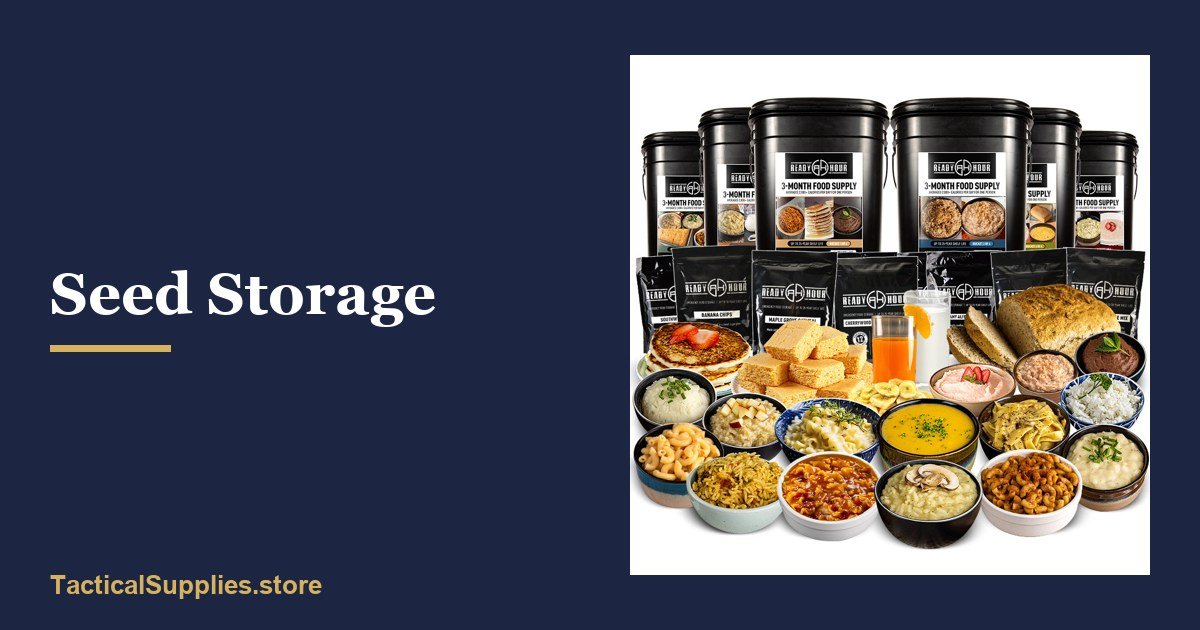
A well-kept seed bank is great insurance, but a garden still takes a full season to feed anyone. Ready-to-eat food covers that gap. The 3-Month Emergency Food Supply from My Patriot Supply feeds one person for three months, or a family of four for three weeks, with a shelf life of up to 25 years when stored properly. It comes in six stackable buckets and needs about 36 gallons of water to prepare the whole supply. Many of the same cool, dry rules apply to food, too, as our guide to the best long-term food storage containers explains.
Frequently asked questions
What is the best container for seed storage?
A moisture-proof container: a glass jar with a rubber seal, a sealed can or a purpose-built seed vault. Colorado State says to choose sealed cans or jars over plastic bags.
Can I store seeds in plastic bags?
Short term, yes. For the long haul, Virginia Extension suggests putting tightly sealed bags inside a jar.
Should seeds go in the fridge or the freezer?
Either works. UNL calls an airtight container in the refrigerator a good location. The freezer can stretch seed life further, but only for dry seed, and repeated thawing does damage (Delaware).
How do I keep moisture out of my seed storage?
Dry seed before storing, use an airtight container, add a desiccant like silica gel or powdered milk, and open packets in a dry room.
The bottom line
Smart seed storage is simple: dry seed, a sealed jar or vault, a desiccant and a cold, dark spot like the fridge. Label everything, keep short-lived seed up front, test every winter and keep stored food on the shelf while the garden grows.
Sources: Colorado State University Extension, Storing Vegetable and Flower Seeds, University of Nebraska-Lincoln Extension, Saving and Storing Garden Seeds, Virginia Cooperative Extension, Seed for the Garden, Iowa State University Extension, Storing Leftover Seeds, University of Delaware Extension, Storing Vegetable Seed, Utah State University Extension, Saving Seeds in Hard Times, Cornell Small Farms Program, How Long Do Seeds Last?, Trustpilot, SeedsNOW reviews. Product details are from SeedsNOW product listings as of November 3, 2026, and My Patriot Supply product pages as of October 27, 2026.